
Politics
‘He lies as if his life depends on it’ – Presidency blasts Peter Obi

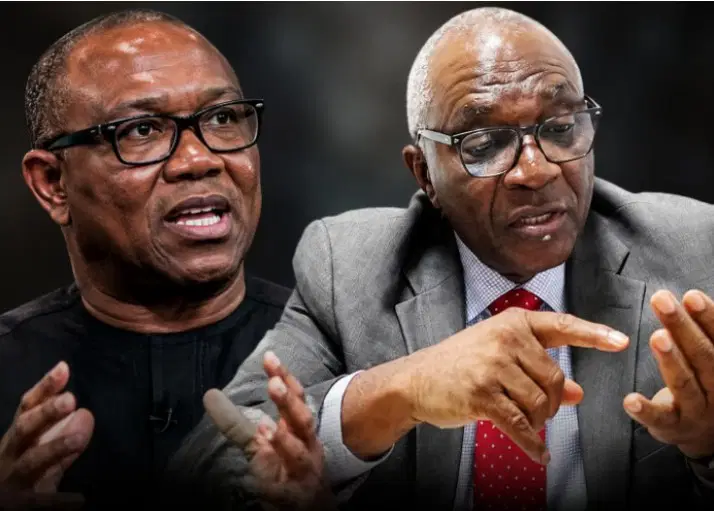
The Presidency has accused the presidential candidate of the Nigeria Democratic Congress (NDC), Peter Obi, of making a false historical claim after he alleged that Nigeria assisted South Korea in paying workers’ salaries during the administration of former President Shehu Shagari.
Bayo Onanuga, Special Adviser to President Bola Tinubu on Information and Strategy, made the allegation in a statement on Friday, insisting that Nigeria’s financial assistance to a foreign country for the payment of workers’ salaries occurred during the administration of former military Head of State, General Yakubu Gowon, and involved Grenada rather than South Korea.
Reacting to Obi’s remarks, Onanuga described the former Anambra State governor as a habitual liar and dismissed his account of Nigeria’s relationship with South Korea under Shagari.
“His Excellency Peter Obi has dropped another lie: that under President Shehu Shagari (1979-1983), Nigeria helped to pay the salaries of South Korean workers. I think this man operates from the stratosphere of falsehood. He lies as if his life depends on it. Lies are his oxygen,” Onanuga said.
He added, “At this stage, I give up on Peter. As a liar, he is incurable.”
Onanuga explained that Nigeria experienced an oil boom following the civil war in 1970, resulting in substantial foreign exchange earnings.
According to him, Gowon once remarked during a tour of the Caribbean that Nigeria’s challenge was not a shortage of money but how to spend its earnings.
He said the former military leader subsequently provided financial assistance to Grenada to enable the country to pay its workers.
However, Onanuga argued that Nigeria’s economic situation deteriorated during Shagari’s administration following a decline in international oil prices, foreign exchange shortages and rising foreign debt.
He also listed shortages of essential commodities, the suspension of new government employment and difficulties in meeting financial obligations among the economic challenges confronting the country before the military coup of December 31, 1983.
“Please ask Peter how a poor country could have afforded to pay South Korean workers when it struggled to pay its workers a minimum wage of N125,” he added.
Obi had made the disputed claim while discussing how Nigeria could achieve economic development by studying countries that had successfully transformed their economies.
The former governor cited China, India, Indonesia and South Korea as examples of countries that had made progress by learning from successful economies and adopting policies that supported their development.
Defending his approach, Obi said countries seeking progress must learn from those that had achieved measurable success rather than rely on unsuccessful examples.
“Let me tell you, whenever people say I’m making reference to China, Indonesia and the rest, for you to progress, you must make reference to those who are doing it well. That’s how life is. You can’t make progress by using bad examples,” he said.
He further claimed that he had studied 31 countries to understand the factors behind their development and identify lessons Nigeria could adopt.
Referring specifically to South Korea, Obi asked: “Do you know that under Shagari, Nigeria helped South Korea to pay salaries?”
He lamented Nigeria’s development trajectory, arguing that South Korea, which he said was once at a comparable level of development, had since recorded significant economic growth.


 Follow Us on Google Discover




‘He lies as if his life depends on it’ – Presidency blasts Peter Obi

2027: ‘It will be a miracle for Atiku or Obi to step down’ – Rufai Oseni

EFCC drags woman to court over alleged N62.5m pilgrims fraud

Nigeria moves to host inaugural U-17 Women’s Africa Cup of Nations

2027: Peter Obi won’t win Lagos again, We were blindsided in 2023 – Fashola declares

COOU ASUU threatens industrial action over unimplemented 2025 FG agreement

Fury gets medical clearance for Anthony Joshua fight amid wife’s mental health controversy

NANS blasts LASUED over fee hike, demands immediate reversal

EPL: Bruno Fernandes sign new Man United contract until 2028

Fresh controversy as Chinese nationals allegedly appear multiple times on voter register, INEC keeps mum

OK Movement withdraws campaign, mobilisation support for NDC, dumps Peter Obi ahead Of 2027 election

Adeleke takes oath of office for second term as Osun Governor

Shettima leads political heavyweights, traditional rulers to Adeleke’s second-term inauguration

Sanwo-Olu suspends November environmental sanitation for INEC mock polls

2027: Supreme Court upholds Arobo as APC candidate for Owo/Ose federal constituency

Just-In: You are just a ‘useful errand boy for now’, your usefulness will be outlived soon – Gov Uzodimma claps back at Wike

Exclusive: Makinde adopts Atiku as preferred presidential candidate for 2027 as alliance talks reach conclusion

Wike plotting to rig 2027 elections – Imo APC

2027: ‘Tinubu in big trouble, won’t be on ballot’ – Adetokunbo Pearse give reason
OK Movement withdraws campaign, mobilisation support for NDC, dumps Peter Obi ahead Of 2027 election

2027: ‘Where will he get the votes?’ – Shehu Sani says Atiku will be defeated by Tinubu

Kwankwaso accuses Kano Governor Yusuf of using EFCC to tarnish his reputation

‘I am pleased with his performance’ – Babangida declares support for Tinubu’s 2027 re-election

Fashion icon Veruschka, German Supermodel dies at 87

‘My finances were better before Tinubu’s Govt’, but Nigerians must feel the pain to reap the benefits’ – Seyi Law

Verified voters in Nigeria now above 100m – INEC Chairman Amupitan

2027: Opposition coalition talks gather momentum as Atiku, Obi, Makinde, Duke meet Nov 30
Fresh controversy as Chinese nationals allegedly appear multiple times on voter register, INEC keeps mum

Akwa Ibom emerges Nigeria’s cleanest State again, maintains nine-year winning streak
