
Politics
Tinubu, APC deny forged NYSC Certificate, urge court to dismiss Atiku’s suit

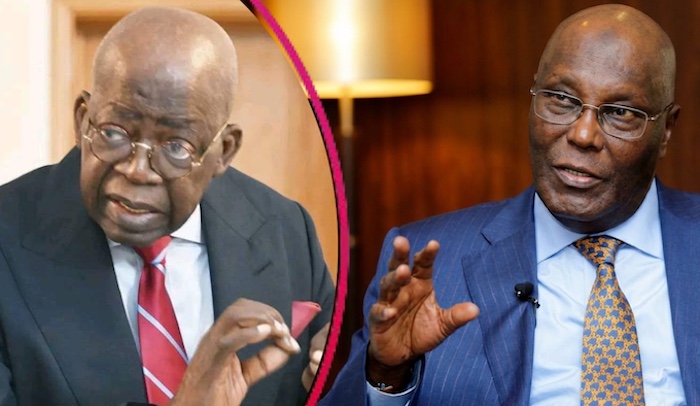
President Bola Ahmed Tinubu and the All Progressives Congress (APC) have urged the Federal High Court in Abuja to dismiss a suit filed by the presidential candidate of the African Democratic Congress (ADC), Atiku Abubakar, challenging Tinubu’s eligibility to contest the 2027 presidential election.
Atiku and the ADC, in suit No. FHC/ABJ/CS/1888/2026, sued Tinubu, the APC and the Independent National Electoral Commission (INEC), seeking the disqualification of the President and the ruling party from the 2027 election.
The plaintiffs alleged that Tinubu submitted a forged National Youth Service Corps (NYSC) discharge certificate to INEC.
However, Tinubu and the APC, in a joint counter affidavit filed on Thursday, denied the allegation, insisting that none of the documents submitted by the President to INEC for the 2023 or 2027 presidential elections was forged.
The APC Director of Legal Services, Sanusi Samaila, who deposed to the counter affidavit dated September 8, said Tinubu did not submit Form CF001 to INEC for either election in the manner alleged by Atiku and the ADC.
“The 1st defendant (Tinubu) emphatically denies the plaintiffs’ allegation of forgery and submission of a forged certificate to the 3rd defendant (INEC) for the 2023 or 2027 presidential elections,” Samaila stated.
He further argued that the NYSC had never disowned the discharge certificate allegedly issued to Tinubu after his service year.
Samaila said none of Tinubu’s documents submitted to INEC for the 2023 and 2027 elections was forged, adding that the commission accepted his educational qualifications and NYSC discharge certificate and subsequently published his particulars as the APC presidential candidate.
The APC also argued that Atiku and the ADC had no legal basis to challenge Tinubu’s emergence as the APC presidential candidate because neither participated in the party’s presidential primary.
According to Samaila, Atiku was neither an APC member nor an aspirant at the party’s presidential primary held in May, where Tinubu emerged as the candidate.
He argued that the plaintiffs were not alleging any breach of the Constitution or Electoral Act arising from the conduct of the APC primary, but were instead challenging the nomination and submission of Tinubu’s name to INEC for the 2027 election.
Samaila added that the APC submitted its candidates’ names to INEC in a letter dated June 26, while the commission acknowledged receipt of Tinubu’s profile on July 11.
In a written address filed by counsel to Tinubu and the APC, Akin Olujimi, the defendants raised several preliminary objections to the suit.
Olujimi argued that forgery, being a criminal allegation, must be established beyond reasonable doubt in accordance with the Evidence Act.
He maintained that Atiku and the ADC had failed to provide any document from the NYSC disclaiming the certificate they alleged was forged.
“It is a settled law that the evidence required to prove that a certificate is forged is a disclaimer from the institution that issued the certificate,” he argued.
The lawyer further submitted that the plaintiffs had not produced either the original document from which the alleged forgery was made or the document they claimed was forged.
He also argued that the plaintiffs bore the burden of proving their claims because they were seeking declaratory reliefs.
“We submit further that this being a declaratory action, the plaintiffs have the burden to prove their case. A declaratory relief is not granted by the court as a matter of course,” Olujimi stated.
The defendants also argued that parts of the suit were statute-barred, claiming that one of the reliefs should have been challenged within 14 days of the alleged submission of the certificate.
Olujimi argued that another relief dependent on the contested claim should consequently be struck out.
He further described the case as incompetent, arguing that it did not fall within the category of pre-election matters contemplated by Section 285(14) of the 1999 Constitution and Section 29(5) of the Electoral Act 2026.
According to him, Section 29(5) allows an aspirant who participated in a political party’s primary to challenge the conduct of that primary.
Olujimi consequently argued that Atiku and the ADC lacked the legal standing to challenge Tinubu’s emergence as the APC candidate because they did not participate in the party’s primary.
He cited a Supreme Court decision which, according to him, described persons without a direct interest in another political party’s internal affairs as “mere busybodies” interfering in matters concerning the party.
The defendants further argued that the suit was improperly constituted because the plaintiffs challenged provisions of the Electoral Act without joining the National Assembly, which enacted the legislation, and the Attorney-General of the Federation.
They therefore urged Justice Inyang Ekwo to uphold their preliminary objections and dismiss the suit.
The Federal High Court in Abuja is currently hearing the matter.


 Follow Us on Google Discover










Atiku returns to Nigeria from overseas trip, set to lead ADC campaign across all 36 states

‘Tinubu must go, he lacks capacity, energy to govern Nigeria’ – Peter Obi

2027: Withdraw from Presidential race, back Tinubu – Kaduna APC tells Atiku

Newborn, parents cheat death as fire destroys buildings in Kwara

Kalu: Tinubu approves 500,000 solar lights for South-East communities

DSS charges Kaduna man over fake Tinubu letter to US president

‘I won’t steal Nigeria’s money, wont allow anyone steal’ — Obi

FG, Labour resume talks on minimum wage, petrol price dispute

Bandits abduct over 10 passengers, driver travelling from Kebbi to Abuja

Presidency tackles Atiku over economic policy, questions his qualifications

‘Ebola may force postponement of 2027 elections’ – NCDC

BREAKING: Harry Kane wins 2026 Ballon d’Or

‘Nomination Was Unlawful’ — NDC aspirant drags Omo-Agege, party to court

Prof Ochefu rejects NDC Campaign Council appointment, give reason

Burna Boy presents Socrates Award to Bukayo Saka at 2026 Ballon d’Or ceremony

BREAKING: NDC unveils 2027 National Campaign Council, names Babachir Lawal, Galadima to key roles (Full List)

2026 Ballon d’Or: Date, time, venue, streaming details revealed

US Pastor marries second wife, describes monogamy as unbiblical

BREAKING: NCDC identifies two additional suspected Ebola cases, tracks 53 primary contacts

FIFA U-17 Women’s World Cup: Round of 16 fixtures, dates, kick-off times revealed

Outrage as viral video shows JIBWIS members demanding AK-47s, threaten to kill ‘Infidels’ in Enugu, Jos on a Sunday

Lone Ebola patient to be flown out of Nigeria for further treatment

Why data may be used even when mobile data is switched off – MTN

“I know what I came into office to do” — President Tinubu

Reaction trails as APC youth leader Dayo Israel gifts 2026 Toyota Prado SUVs to party officials

NCDC approves ₦100,000 weekly support for people isolated over Ebola concerns
‘Ebola may force postponement of 2027 elections’ – NCDC

Bandits storm Kaduna community, abduct two farmers
Burna Boy presents Socrates Award to Bukayo Saka at 2026 Ballon d’Or ceremony
