National News
Tinubu signs executive order on virtual assets, establishes council to unify crypto operations

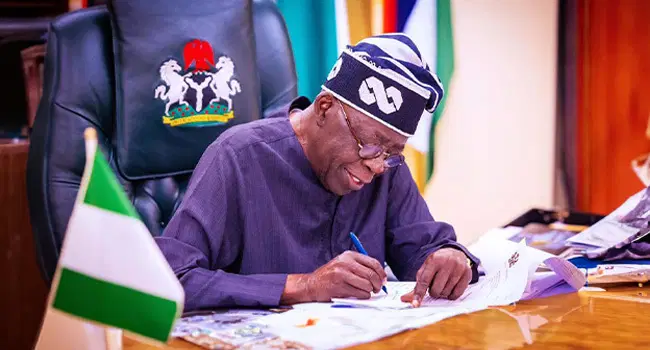
President Bola Ahmed Tinubu has signed the Presidential Executive Order on Virtual Assets Coordination, 2026, creating a new framework to harmonise the regulation of virtual assets across Nigeria.
The Executive Order, signed pursuant to Section 5 of the 1999 Constitution (as amended), takes immediate effect and is aimed at strengthening oversight of the country’s rapidly growing virtual assets ecosystem.
This was disclosed in a statement issued on Friday by the Special Adviser to the President on Information and Strategy, Bayo Onanuga.
According to the Presidency, the order seeks to close regulatory gaps that have allowed fraudulent operators to exploit unsuspecting Nigerians while positioning the country to benefit from responsible innovation in the digital economy.
The statement noted that the rapid growth of virtual assets has blurred the traditional boundaries between currencies, money, commodities and securities, resulting in fragmented regulation among relevant agencies.
It added that the absence of coordinated oversight had exposed Nigeria to risks including money laundering, terrorism financing, cybercrime, data privacy breaches, fraud and significant revenue losses.
“Too often, unregistered and fraudulent operators have exploited these gaps to prey on unsuspecting Nigerians, costing families their savings,” the statement said.
To address the challenges, the Executive Order establishes a Virtual Asset Council to be chaired by the Central Bank of Nigeria (CBN), with the Nigeria Revenue Service (NRS) and the Securities and Exchange Commission (SEC) serving as vice-chairmen.
Other members of the council include the Nigerian Financial Intelligence Unit (NFIU) and the Office of the National Security Adviser (ONSA).
The council will provide policy direction, promote inter-agency collaboration and work with the Attorney-General of the Federation to develop a harmonised legal and institutional framework aligned with Nigeria’s economic, security and social objectives.
The order also creates a Virtual Asset Office, which will serve as the council’s operational arm, with its secretariat domiciled at the Central Bank of Nigeria.
According to the Presidency, the office will coordinate information sharing, regulatory applications and reporting among participating agencies through an integrated supervisory technology platform while allowing each agency to retain ownership and control of its data.
The Federal Government clarified that the Executive Order does not establish a new regulator or transfer statutory powers from existing agencies.
“Each institution retains its full statutory mandate and independence, and the framework coordinates their work rather than replacing it,” the statement said.
Under the new framework, virtual asset activities classified as securities will be regulated and registered by the Securities and Exchange Commission, while payment, settlement, custody and other services involving non-security virtual assets will fall under the regulatory supervision of the Central Bank of Nigeria.
Where there is uncertainty over regulatory responsibility, the Virtual Asset Council will determine the appropriate agency, preventing regulatory loopholes previously exploited by unregistered operators.
The Presidency also disclosed that the CBN is proceeding with plans to establish a regulatory sandbox for virtual assets.
The sandbox will provide a controlled environment where eligible operators can test blockchain-based products and virtual asset services under regulatory supervision before they are introduced into the wider market.
According to the statement, the arrangement will enable regulators to evaluate the impact of emerging technologies on monetary sovereignty, financial stability, consumer protection, financial inclusion, market integrity and government revenue.
The CBN is expected to release further details of the sandbox in due course.
In addition, the Nigeria Revenue Service will introduce a dedicated tax policy for the virtual assets industry to provide greater certainty for taxpayers and service providers while improving voluntary tax compliance.
The Federal Government also revealed that it is finalising a comprehensive Virtual Assets White Paper, which will outline Nigeria’s long-term policy direction and implementation strategy for the sector.
Furthermore, the newly established Virtual Asset Council has been directed to produce a Harmonised Implementation Framework within 30 days to ensure the immediate execution of the Executive Order.
Nigeria remains one of the world’s leading countries in cryptocurrency adoption by transaction volume.
While the Central Bank prohibited banks from facilitating cryptocurrency transactions in 2021, effectively driving trading underground, it reversed the policy in 2023 by introducing a regulatory framework for virtual asset service providers.
The Securities and Exchange Commission has also continued efforts to bring digital asset exchanges under formal regulatory oversight.


 Follow Us on Google Discover







2027: Kwankwaso a goat in sheep’s clothing, secretly working for Tinubu – Atiku Campaign Council

DSS arrests Maina’s fugitive son in Abuja, hands him over to EFCC

2027: Step down if you are not working for Tinubu – Deji Adeyanju dares Obi, Kwankwaso

2027: ‘I wont join my Uncle to support Tinubu’ – Davido says

Enugu NYSC death: NAFDAC debunks claims linking corps members death to fake drugs

33 Governors cannot be wrong in supporting Tinubu – Bayo Onanuga

Security forces arrest five suspects over abduction of 20 NYSC members in Imo

Rugby star Hyron Andrews dies at 31 after accidental fall in South Africa

LAUTECH Resident Doctors halt 50-day strike as Makinde intervenes

House Officers, Nurses, Radiographers, Others wanted as DELSUTH opens recruitment – Apply Now

FG raises health fund allocation to N40.76bn, extends insurance to prison inmates

Erisco Foods announces 13 job openings across Nigeria – Apply Now

Tinubu reappoints Bala Bila as INEC commissioner, nominates six others

2027: ‘Don’t trust your destiny to ‘kalokalo’ people’ – Wike warns Rivers voters against Atiku, Amaechi, Obi

BREAKING: Cross River PDP Chairman Venatius Ikem resigns, cites leadership crisis
Erisco Foods announces 13 job openings across Nigeria – Apply Now

2027: Atiku, Obi, Makinde, Adebayo, Duke hold talks with six opposition parties

Ex-Senator Bello Mandiya’s body found in Abuja home three days after he slipped, hit his head in the bathroom
‘You Betrayed Osun People’ — Adeleke, Davido face backlash over support for Tinubu

JUST IN: Finnish Appeal Court reduces Simon Ekpa’s jail term to four years, upholds terrorism conviction
Tinubu reappoints Bala Bila as INEC commissioner, nominates six others

Zamfara govt set to empower 36,176 residents with Dangote shares

Umahi reopens first Niger bridge after emergency repairs, displays Tinubu’s photos

Over 10 soldiers, four civilians feared dead as Boko Haram terrorists attack Borno military base

‘I love Islam, I’ve sent people to Mecca to pray for me, Nigeria for 25 years’ – Akpabio

Lagos govt announces 3-day traffic diversion on Independence bridge for emergency repairs

Tension escalates as thugs attack NDC secretariat in Edo, destroy properties

Tension mounts as NLC rejects FG’s response to 14-day ultimatum

‘Local champion’ – Donald Duke takes fresh swipe at Gov Diri over Lagos-Calabar coastal highway
