
News
Real reason INEC excluded Adebutu, Pantami, others from final governorship candidates’ list

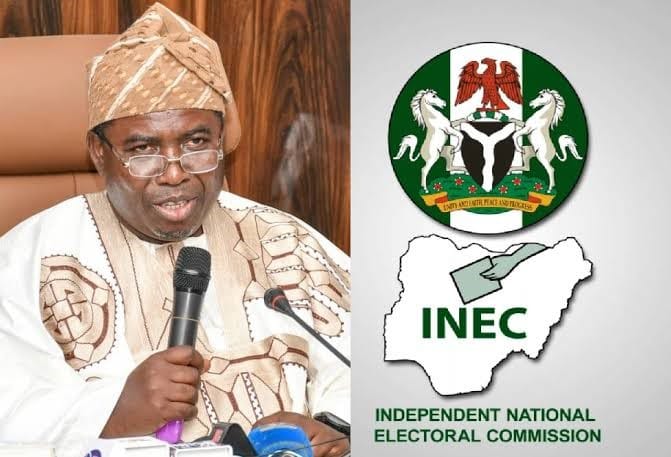
The Independent National Electoral Commission (INEC) has excluded at least four governorship candidates from its final list ahead of the 2027 general elections over alleged non-compliance with provisions of the Electoral Act 2026.
The commission reportedly relied on the Supreme Court’s September 24 judgment on the Electoral Act in removing the candidates from the list released on Saturday.
The affected candidates were excluded because their names were reportedly missing from the electronic registers submitted by their political parties 21 days before their respective primaries, as required by the law.
At least four governorship candidates were affected by the decision.
These are Isa Ali Pantami, Gombe State People Democratic Party (PDP) candidate; Oladipupo Adebutu, Ogun State PDP candidate; Abdulsalam Gwarzo, Kano State Nigeria Democratic Congress (NDC) candidate; and Danjuma La’ah, Kaduna NDC candidate.
Social Democratic Party (SDP) also said four of its candidates were omitted from the final list.
Since the release of the list, there has been outcry and apprehension in the camps of affected political parties and candidates.
The PDP yesterday gave INEC 48 hours to give reasons for the omission, failing which it would unveil the next line of action.
But a top INEC source said categorically that the omission was based on the Supreme Court judgment.
The source said the provisional lists of governorship candidates were rescreened along with the registers of the political parties.
The source said: “Many politicians are negligent and they don’t take matters very seriously. They did not meet the conditions for eligibility as outlined by the law.
“INEC decided to follow the law in its actions and decisions after the Supreme Court judgment.”
The source explained further that the affected candidates are not on the electronic party register submitted to the electoral agency by their political parties.
The source said those affected ran foul of the provisions of the Electoral Act because their names could not be found in the membership registers of the parties that fielded them as candidates.
During the realignments characterised by defections, many politicians were aloof to the provisions of the law, particularly the time frame for party membership registration, the INEC source added.
The governorship election will hold on February 6, next year.
The Supreme Court judgment
A seven-member panel of the apex court, led by Justice Adamu Jauro, set aside the July 16 judgment of the Court of Appeal in Abuja, which voided sections of the Act in a suit brought by the Zenith Labour Party (ZLP).
The ZLP had prayed the court to set aside the provisions, claiming that it amounted to undue interference in the internal affairs of parties by the INEC.
The Supreme Court affirmed the constitutionality of Sections 77(5), 77(6), 77(7), and 84(2) of the Electoral Act 2026, ruling that they do not conflict with the 1999 Constitution (as amended).
The court held that the provisions represent valid statutory regulations rather than unconstitutional interference in party affairs.
Section 77(5) stipulates that only members whose names appear on a political party’s membership register, duly submitted to INEC at least 21 days before any primary, congress, or convention, are eligible to participate.
Also, Section 77(6) mandates political parties to strictly use the official membership register submitted to the Commission for conducting primaries, congresses, and conventions
According to Section 77(7), any political party that fails to submit its membership register within the statutory timeframe is barred from fielding candidates in the affected election.
Candidates’ defections
While the parties fielding the candidates are seeking further clarifications from the commission on the omission, the candidates vowed to challenge the electoral commission over the action.
According to the candidates, the omission translated into exclusion from the elections.
After losing out during the All Progressives Congress (APC) primary in Gombe State, Pantami, former Minister of Communications and Digital Economy, defected to the PDP.
Also, Senator La’ah defected to the NDC in Kaduna State.
Kaduna State NDC Chairman, Mordecai Ibrahim, blamed the omission on discrepancies during the upload of candidates’ particulars in the INEC portal, which he attributed to network failures during the online registration process.
He said repeated attempts by different individuals to register La’ah whenever network problems occurred resulted in a mix-up in the names submitted to INEC.
Ibrahim said: “The problem is that there was a mix-up of names. The person who registered him made a mistake because, each time there were network issues, we got several people to try registering him.”
Giving insight into the omission, the source said that while the candidates defected from their parties to other platforms, they never took cognisance of the law and the time frame.
The source pointed out that many political parties committed infractions by failing to show proof of membership of candidates and running mates in their registers.
He urged political parties and candidates to stick to laws, rules, regulations and guidelines by INEC to avoid embarrassment.
Pantami’s legal team has written a protest letter to the electoral agency demanding his restoration as a candidate.
In a letter dated October 12, Ahmed Raji (SAN); A.T. Kehinde (SAN); Abdul Mohammed (SAN); Wale Balogun (SAN); and Chief Tunde Falola described the omission as “unlawful and unexplained.”
They described the former minister as a duly registered member of the PDP in Pantami Ward, Gombe State.
They added that the updated party membership register containing his name was submitted to INEC.
The lawyers also claimed that Pantami, who purchased the expression of interest and nomination forms, was screened and cleared and that he won the PDP governorship primary held on 26 May.
According to the lawyers, his personal particulars (Form EC9) were submitted to INEC on August 8, and the Commission published his name on August 29.
However, the outcome of the primary was challenged at the Federal High Court in Gombe.
The court, in judgments delivered on September 24, nullified the May 26 primary on grounds relating to its conduct.
The lawyers claimed that the court resolved questions about Pantami’s membership and eligibility against the plaintiffs, holding that he was a recognised member of the PDP and that membership is primarily an internal party affair.
The lawyers said: “The court ordered the PDP to conduct a fresh governorship primary within 30 days, allowing all previously cleared aspirants to participate.
“The fresh primary was held on September 29. INEC officials monitored the exercise, and Pantami again emerged as the winner. His name was resubmitted to the Commission as the PDP’s nominated candidate.”
The lawyers said that once a candidate has been validly nominated, only a court of law can remove the candidate’s name.
They cited several Supreme Court and Court of Appeal decisions to the effect that INEC’s role is limited to attending, observing, monitoring and reporting on primaries, and that the Commission has no power to unilaterally disqualify or omit a nominated candidate.
The lawyers therefore demanded that INEC should, before tomorrow, publish and circulate Pantami’s name as the PDP candidate for Governor of Gombe State “in the same manner and with the same prominence” as the other candidates whose names appeared on the October 10 list.
PDP gives INEC 48 hours to explain omission
The PDP also gave INEC 48 hours to explain why Adebutu and Pantami were omitted from the final list of governorship candidates.
The party threatened to seek legal redress if INEC fails to provide a satisfactory explanation for the omission.
National Publicity Secretary, Jungudo Haruna Mohammed, said the party had written to the commission, insisting that both candidates met the requirements for nomination.
Speaking on a Television Continental (TVC) programme, Mohammed said: “It is shocking and disappointing that after a political party has done all that is required legally, its candidates will be omitted from INEC’s final list in the 2027 general election.
“The PDP, as Nigerians know, has faced similar challenges and we have come out triumphant. This, too, will not be different. As of this morning (yesterday), we have officially communicated to INEC in writing.”
Mohammed said the party had yet to receive any concrete legal or administrative explanation for the omission.
He dismissed suggestions that a Supreme Court decision might have informed the commission’s action, insisting that Adebutu and Pantami were registered members of the PDP and that their names appeared in the party’s register.
He said the omission might have resulted from an administrative error and questioned the basis for removing the candidates from the list after their particulars had been published.
He asked: “INEC had earlier published the names. Why is it that their names are omitted?”
The PDP spokesman urged the commission to explain the circumstances surrounding the decision, warning against speculation while the party awaited clarification.
“We would prefer that INEC should come clean to tell us the issues. Let us allow INEC to come out and tell us what the issues are,” he said.
He said the PDP had given INEC a timeline to address the matter, adding that the party would consider its legal options if the commission failed to provide convincing reasons.
“If INEC has reason or reasons for excluding these names, it should not take them more than 48 hours to give us their reasons. But, if those reasons are not convincing enough, we would be left with exploring all options to seek redress,” he said.
Mohammed said the PDP could not afford to lose Ogun and Gombe states or allow the candidates who had complied with laws and guidelines to be excluded from the electoral process.
He also rejected the insinuation that the party’s internal crisis might have contributed to the omission, maintaining that the candidates had fulfilled the relevant requirements.


 Follow Us on Google Discover







Press Freedom Advocate Livinus Victor demands public apology from Abike Dabiri-Erewa over Journalism remarks

BREAKING: APC revises Tinubu Campaign Council, names Wike, Adeleke, Soludo as FCT, Rivers, Osun, Anambra coordinators (Full List)

FG demands arrest, prosecution of suspect in stabbing of Medical Scientist in Ogun

2027: Economic hardship, appointments threaten Tinubu’s support in Northern Nigeria

One Week after NAF crash, search for Black Box, victims’ remains continues in Ondo swamp

My Father’s reforms are intended to secure Nigeria’s future – Seyi Tinubu

Real reason INEC excluded Adebutu, Pantami, others from final governorship candidates’ list

‘Oyedele lacks right educational background to manage Nigeria’s economy’ – ADC spokesperson

BREAKING: Police arrest former Imo governor Rochas Okorocha in Abuja

Kwara Gov presents 25 Hilux vehicles to Police, plans 100 for security agencies

Amaechi accuses Akpabio of seizing Cross River oil wells

‘Tinubu Must Go’ – He’s planning to obtain fresh $20bn loan for Coastal Highway project – Atiku

Dangote refinery extends IPO offer period by two weeks, sets new deadline

BREAKING: Publish my name within 72hrs or else…. – Pantami give INEC ultimatum

2027: Shettima meets Yahaya Bello, Badaru, other political leaders at Presidential Villa

Dangote Group opens 86 vacancies in Engineering, Finance, Logistics, HR, other fields

ECOWAS Bank opens applications for 2026 Young Professionals Programme

2027 Elections: INEC publishes final list of governorship candidates nationwide (Full list)
BREAKING: Police arrest former Imo governor Rochas Okorocha in Abuja

Christopher University announces staff recruitment for academic, administrative positions

JUST IN: US publishes names, identities of 24 Nigerians facing deportation

INEC names Tinubu, Atiku, Obi, 15 others in 2027 presidential race (Full List)

‘Our ransom has been refunded’, says parents of abducted NYSC member

Latest World Bank report proves our reforms are working – Tinubu

2027: Obi is a ‘packaged fraud’, he’s secretly working for Atiku, positioning himself to become SGF – Sowere alleges

Names of 68 lawyers elevated to SAN rank (Full list)
BREAKING: APC revises Tinubu Campaign Council, names Wike, Adeleke, Soludo as FCT, Rivers, Osun, Anambra coordinators (Full List)

Ex-Akwa Ibom University SUG President dies at Enugu NYSC camp

Amnesty International raises alarm, urges Wike to halt Maitama demolitions
