
Politics
Rainbow Coalition: APC begins talks to reconcile Wike, Party Governors
The move follows concerns within the ruling party that the disagreement could deepen and create complications for President Bola Ahmed Tinubu’s re-election campaign.

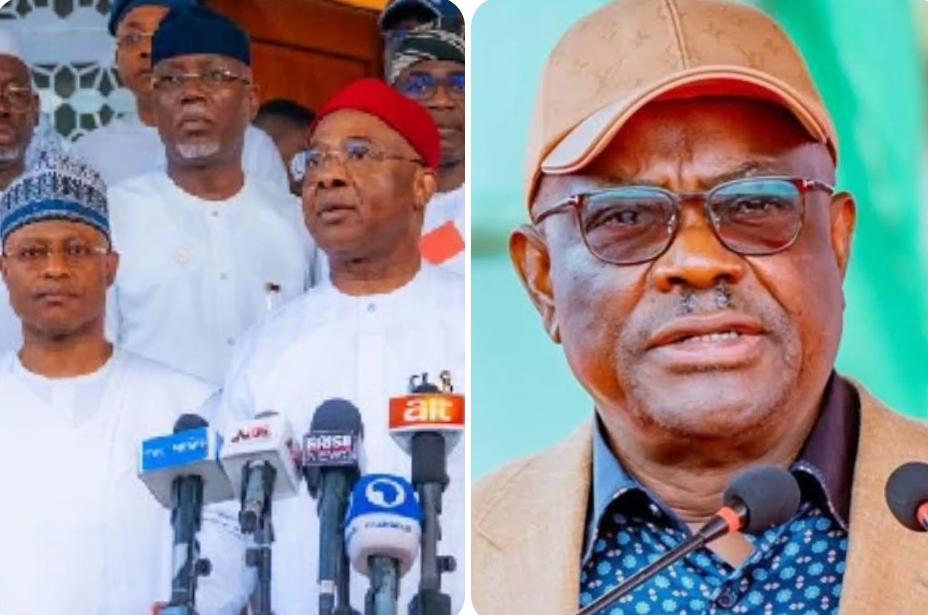
The national leadership of the All Progressives Congress (APC) has begun efforts to resolve the growing disagreement between the Minister of the Federal Capital Territory, Nyesom Wike, and governors elected on the party’s platform over the activities of the Rainbow Coalition ahead of the 2027 elections.
The move follows concerns within the ruling party that the disagreement could deepen and create complications for President Bola Ahmed Tinubu’s re-election campaign.
At the centre of the dispute is whether opposition politicians supporting Tinubu through the coalition should also support APC candidates contesting governorship, National Assembly and State House of Assembly elections.
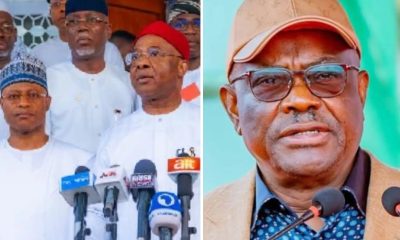
The Progressive Governors’ Forum, led by Imo State Governor Hope Uzodimma, has maintained that APC governors would support Tinubu’s re-election as well as candidates contesting on the party’s platform at all levels.
Wike, however, has consistently maintained that his political support is specifically for Tinubu and does not extend automatically to other APC candidates.
A member of the APC National Working Committee told Daily Sun that although Wike and the APC governors were united in their support for Tinubu’s re-election, they could find themselves on opposing sides in governorship and legislative contests where coalition-backed candidates face APC flag bearers.
The NWC member said the Rainbow Coalition could have its own political agenda separate from the APC.
“Yes, they are working for the same purpose of facilitating the re-election of Mr President, but it does not mean that the rainbow coalition may not have their own agenda.
“If the Rainbow Coalition wants to elect a candidate into the House of Assembly who is not an APC candidate, what it means is that they are competing against the APC.
“Whatever rainbow coalition means, APC is a party, not a coalition.”
According to the party official, APC governors were particularly concerned about a situation in which supporters could vote for Tinubu in the presidential election and then support candidates from other parties in legislative contests.
“The only issue that the governors may be pointing to is to avoid a situation where the electorate will take instructions from the coalition to vote for non-APC candidates after voting for Mr President,” he said.
He urged those involved to resolve the disagreement through political consultations rather than public exchanges.
“The situation requires a high level of strategic networking, not this media war, to streamline the arrangement and ensure that the people understand what they are doing,” he said.
The NWC member also stressed that support for Tinubu through the coalition did not amount to an agreement for APC members to support candidates from other parties.
“The fact that the coalition supports APC to elect President Tinubu does not mean therefore that APC members are supposed to vote for the candidates of other parties in the name of coalition,” he said.
He confirmed that the APC leadership would intervene, noting that the process would require engagement at multiple levels.
“However, the party will definitely wade into it, but you know that it requires multi-level engagement,” he said.
Governors Reject Support for Non-APC Candidates
The disagreement became public after the Progressive Governors’ Forum rejected any political arrangement it considered capable of weakening the APC or affecting its candidates.
Uzodimma said the governors had resolved not to participate in or support political arrangements involving candidates outside the APC.
“The APC Governors Forum unanimously resolved that its members will not participate in, support or endorse any alliance or political arrangement capable of undermining the re-election of Mr President, weakening the APC or adversely affecting any candidate of the party at all levels,” he said.
He added that the governors’ campaign structure would be built around the APC’s entire ticket.
“In other words, the forum has no intention to support any candidate at any level that is not an APC candidate because our candidates who are contesting the election are being sponsored by our party.
“The governors’ campaign commitment is exclusively to all APC candidates. All levels of the party campaign architecture will align with the expectations of Mr President and the strategic objectives of the party,” Uzodimma said.
Wike Insists Support Is for Tinubu
Reacting to the governors’ position, Wike maintained that he had never agreed to support APC candidates in other elections as part of his backing for Tinubu.
“What I said and stand for is that I will mobilise support for the re-election of the President. I never promised anyone that PDP will not field candidates to contest governorship, National Assembly and State House of Assembly elections,” he said.
The minister also rejected the suggestion that the Rainbow Coalition was an alliance with the APC.
“Most importantly, the Rainbow Coalition has nothing to do with the APC. Rather, it is our own way of mobilising support across political parties for Mr President, who has done well to deserve a second term.”
Wike recalled that he and other members of the G5 supported Tinubu in the 2023 presidential election without first reaching an agreement with the APC.
“I never met with the All Progressives Congress before I and other members of the G5 supported the President in 2023. And for 2027, my support is for the President only,” he said.
The minister also challenged Uzodimma’s argument that supporting candidates outside the APC could affect Tinubu’s performance in the presidential election.
He pointed to the 2023 elections in Imo, Ebonyi, Abia and Enugu, where voters supported APC candidates in some National Assembly contests despite giving Tinubu relatively low presidential votes.
“In Imo State under Governor Hope Uzodimma, how did APC win two Senate seats in 2023, in an election held the same day as that of the President, and APC had less than 15 per cent in the presidential election? Was it a rainbow coalition? Were the voters confused?” Wike asked.
He similarly cited APC victories in National Assembly elections in Ebonyi, Abia and Enugu, arguing that voters could make different choices in presidential and legislative elections held on the same day.
“Was it the rainbow coalition that also made APC win National Assembly elections in Ebonyi, Abia and Enugu states where the President did not have 10 per cent of the votes?” he asked.
Wike added that voters in the affected states could make separate choices in different elections.
“If in 2023, the voters in Imo, Abia, Enugu and Ebonyi voted APC in the senatorial election and voted another party in the presidential election, they won’t be confused in 2027, provided we all support the President genuinely this time?”
He maintained that political actors should address their local political contests separately from the presidential election.
“Politics is local, and those having problems in their states should resolve them instead of using the re-election of the President to whip up sentiments. I won’t be the one to help people to win elections in their states.”
Wike said the coalition’s immediate focus remained mobilising support for Tinubu’s re-election, after which politicians could concentrate on their respective state contests.
“After the President has been re-elected, we can all go and face elections in our states,” he said.
The APC leadership’s intervention comes as political actors continue to debate how the various alliances and support groups backing Tinubu will operate alongside the ruling party’s candidates across the different levels of the 2027 elections.


 Follow Us on Google Discover




BREAKING: Police storm King’s College, seal off entrance amid parents’ protest

Drama at Education Ministry as workers block entrance, chant ‘Alausa must go’

10 things you should know about late Nollywood veteran, Olu Jacobs
BREAKING: Veteran Nollywood actor Olu Jacobs dies at 84

Remi Tinubu gives N20m to Nigerian Qur’anic Competition winner Maryam Dan’Azumi

Rainbow Coalition: APC begins talks to reconcile Wike, Party Governors

‘We Can’t Subsidise Everything’ — Dangote speaks on petrol price, crude cost

2027: Students across 19 Northern states, FCT endorse Tinubu for re-election

Messi named in Argentina squad for farewell match

Gov Aiyedatiwa gives kidnappers 14 days deadline to vacate Ondo forests

Nasarawa JUSUN embark on indefinite strike over unmet demands

Lagos Assembly passes 2026 budget amendment bill

‘They are politically lazy’ — Wike fires back at APC Govs over Rainbow Coalition

2027: To rig election now is very difficult, but Tinubu will score over 12 Million votes – Ayodele Fayose

Ogun 2027: Adeola gives Hunye, Marcus-Bello 24 hours to prove Ekiti origin claim

International Breweries Recruitment: 5 Job vacancies across Nigeria (How to Apply)

Food and Agriculture Organization Of the United Nations (FAO-UN) announces 4 recruitment vacancies across Nigeria (How to Apply)

Nile University of Nigeria announces recruitment for 9 vacancies (How to Apply)

Philomath University announces recruitment for 22 vacancies (How to Apply)

15 feared killed as gunmen strike Plateau communities

2027: NDC says Nigerians can fund party with contributions as low as N1,500

Rainbow coalition is not an APC structure, I never promised Tinubu, APC that PDP won’t field candidates in 2027 – Wike replies APC Governors

Show proof I left Anambra with debts, I’ll stop my 2027 campaign – Obi dares Soludo
2027: Big battle for Wike as APC Govs move against Rainbow Coalition, parallel structures capable of undermining Tinubu, APC candidates

600 Northern Lecturers who attended Tinubu endorsement show must be bared 2027 election duties – ADC warns INEC

‘I Don’t Want to Be Called Africa’s Richest Man Again’ — Dangote

Real Warri Pikin apologises after viral on-stage moment with Timaya (Video)

2027: Support Tinubu as he supported Buhari, Yari urges Northerners
Petrol at N1,350 in Nigeria still cheaper than in neighbouring countries – Dangote
