
National News
Tinubu transmits State Police Bill to Senate as govs push for greater security powers

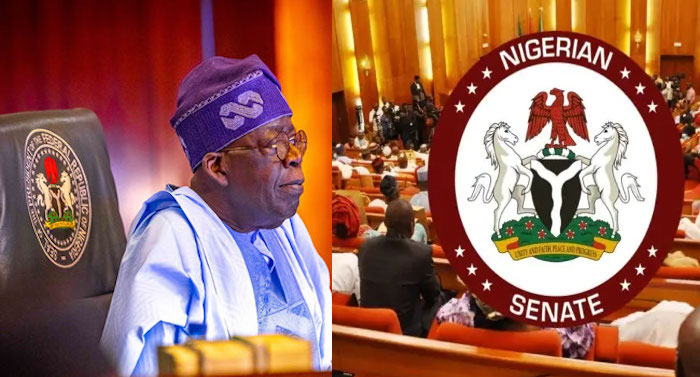
President Bola Tinubu has formally transmitted the proposed State Police Bill to the Senate, setting in motion what could become one of the most far-reaching reforms of Nigeria’s security architecture since the return to democratic rule.
The proposed constitutional amendment seeks to create a legal framework for the establishment of state police services across the federation, a move advocates believe will strengthen security management and bring policing closer to local communities.
Senate President Godswill Akpabio, who read the President’s letter during plenary on Tuesday, assured Nigerians that adequate safeguards would be built into the proposed law to prevent abuse of state police formations by governors and other political office holders.
According to Akpabio, accountability mechanisms will be central to the new policing structure to ensure that decentralised policing does not become a tool for political intimidation.
In his communication to lawmakers, President Tinubu described the bill as a critical component of his administration’s efforts to reorganise Nigeria’s security system and improve the protection of lives and property.
The President noted that the proposal builds on previous work carried out by both chambers of the National Assembly and incorporates additional safeguards designed to ensure the effective operation of a dual policing system.
“This bill seeks to amend the Constitution of the Federal Republic of Nigeria, 1999, to create a constitutional pathway for the establishment of State Police services in Nigeria,” Tinubu stated.
He added that the measure forms part of his administration’s broader strategy to address evolving security challenges across the country.
Following the transmission of the bill, the Senate referred it to the Constitution Review Committee chaired by Deputy Senate President Jibrin Barau, with instructions to present its report on Wednesday for immediate consideration.
Akpabio said the Senate would adopt accelerated legislative procedures to ensure speedy consideration of the amendment before lawmakers proceed on annual recess.
He described the proposal as a historic opportunity to decentralise policing and strengthen community participation in security management.
“Since 1960, Nigeria has not had the courage to decentralise policing. This is the first time we are taking that step,” Akpabio said.
The Senate President argued that local communities possess valuable intelligence that could help security agencies prevent crimes before they occur, adding that a decentralised policing structure would improve response times and strengthen public safety.
However, despite broad support for the proposal, state governors have continued to push for greater constitutional powers over state police operations.
Governors are seeking stronger control over appointments, operational decisions and security coordination within their states, insisting that effective state policing must align with the principles of federalism.
Funding also remains a major issue in discussions surrounding the proposal.
Some stakeholders have questioned suggestions that three per cent of allocations from the Federation Account Allocation Committee (FAAC) should be dedicated to funding state police operations, arguing that such an amount may be insufficient to sustain salaries, equipment procurement and operational costs.
Governors have also expressed concerns about the sustainability of the proposed funding model and have called for clearer constitutional guarantees to ensure long-term viability.
Another area of concern relates to the governance structure proposed for the National Police Coordination Council, which would oversee aspects of coordination between federal and state police institutions.
Some stakeholders fear the arrangement could create bureaucratic bottlenecks and potentially allow political interference in policing matters.
Despite these concerns, supporters of the reform insist that Nigeria’s current centralised policing system is no longer adequate for a country of more than 230 million people facing complex security threats.
Deputy Speaker of the House of Representatives, Benjamin Kalu, said the State Police Bill represents one of the most important security reforms currently before the National Assembly.
He argued that officers recruited from local communities are better positioned to understand local realities, gather intelligence and respond effectively to emerging threats.
Kalu also stressed that the proposed legislation contains safeguards designed to prevent misuse by state governments, including independent oversight mechanisms, merit-based recruitment and constitutional restrictions on political interference.
The House of Representatives had earlier approved constitutional amendment proposals supporting the creation of state police, making the Senate’s consideration of the bill a crucial next step in the legislative process.
If eventually approved by the National Assembly and ratified by state Houses of Assembly, the amendment would fundamentally reshape Nigeria’s policing framework and security governance structure.


 Follow Us on Google Discover





My gov’t correcting past mistakes, give me more time to ‘finish the good work’ – Tinubu appeals to Nigerians

Gunmen kill four, injure two in Niger

Super Eagles begin AFCON 2027 qualifiers with 2-1 win over Madagascar

ADC hit by fresh crisis as National youth leader Sultan Bello resigns

Appeal Court affirms two-year jail sentence for ex-Unical Dean, Ndifon

DisCos record N205.53bn electricity revenue in July – NERC

Super Falcons defender Ohale announces retirement from international football

‘I respect Tinubu, I can never abuse him’ – Peter Obi

Cristian Romero replaces Messi as Argentina’s new Captain

NDLEA arraigns KayCee Luxury, two others over alleged 184.5kg cocaine export

Workers shut down Delta secretariat over deputy director’s death

Anyone praying for fuel subsidy return does not mean well for Nigeria – Alex Otti

Obi-Soludo debt row deepens as Anambra releases N363m document on workers’ arrears after Obi denied borrowing

Okoye arrives Super Eagles camp ahead of AFCON qualifier against Madagascar

Tinubu-Related Drug Records: U.S. DEA warns release could expose confidential sources, techniques

ECOWAS opens recruitment for qualified nationals across multiple sectors – Apply Now

British Council opens recruitment opportunities across Nigeria – Apply Now

BREAKING: Atiku appoints Akobundu DG of ADC Presidential Campaign Council, names El-Rufai Deputy Chairman (Full List)

Flour Mills of Nigeria opens recruitment for multiple positions across Nigeria – Apply Now

Former Super Eagles captain William Troost-Ekong converts to Islam, recites Shahadah in Doha

A Litre of petrol costs over ₦3,000 in UK, Nigerians are enjoying — Gov. Okpebholo

Atiku donates ₦20m to families of 37 Miners who died in NSCDC custody

Shanahan University announces 13 vacancies for Medical, ICT, Admin Workers – Apply Now

‘US cannot afford to let Tinubu rig 2027 Polls’ — Von Batten-Montague-York

BREAKING: Court nullifies Pantami’s PDP ticket, orders fresh Primary in Gombe

Rainbow Coalition: Wike-Uzodimma rift splits APC Governors into camps
Tinubu-Related Drug Records: U.S. DEA warns release could expose confidential sources, techniques

‘I hold no grudge against those who chose not to stand by me’ – El-Rufai

FIFA picks Nigerian referee for U-17 world cup
