
Editorials
10,800 Residents, 2,700 buildings may face displacement, demolition as FG expands Lagos-Calabar Coastal Highway

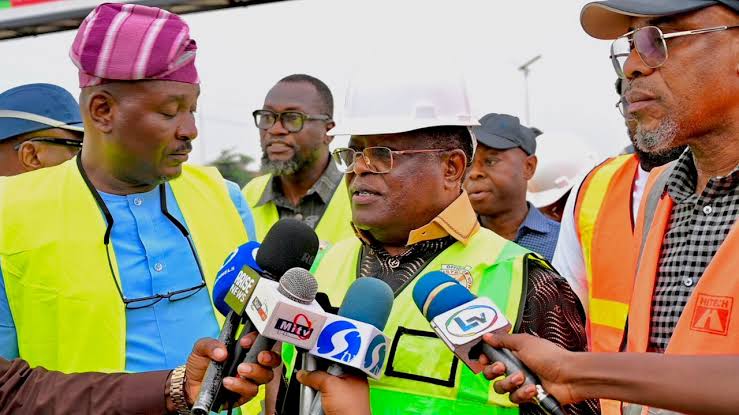
The Federal Government’s decision to demolish buildings located within a newly identified 15-metre setback along the Lagos-Calabar Coastal Highway corridor has reignited controversy over the planning and execution of one of Nigeria’s largest infrastructure projects.
The latest directive, announced by the Minister of Works, David Umahi, will pave the way for the construction of service lanes and additional drainage infrastructure intended to improve accessibility, traffic safety and flood management along the coastal highway. However, the decision has left thousands of residents, landlords, developers and investors facing fresh uncertainty over properties that now fall within the expanded corridor.
Current estimates by industry stakeholders suggest that between 1,700 and 2,700 buildings could ultimately be affected. Estate Surveyor and Valuer, Olusola Enitan, estimates that between 17,000 and 54,000 residents may be directly impacted, depending on household sizes.
According to the Federal Government, all affected property owners with valid entitlements will receive compensation in accordance with existing laws.
The Lagos-Calabar Coastal Highway remains one of President Bola Tinubu’s flagship infrastructure projects. The proposed 700-kilometre highway is expected to connect nine coastal states—Lagos, Ogun, Ondo, Edo, Delta, Bayelsa, Rivers, Akwa Ibom and Cross River—while boosting regional trade, tourism, transportation and economic development.
Construction commenced in March 2024, with the first 47.47-kilometre section stretching from Ahmadu Bello Way in Victoria Island to Eleko Junction in Ibeju-Lekki. The section was awarded at N1.068 trillion under an Engineering, Procurement, Construction and Financing (EPC+F) arrangement being executed by Hitech Construction Company Limited.
While government insists the project remains transformational, the latest demolition announcement has generated fresh debate over whether the proposed service lanes formed part of the original engineering design or represent a major design modification introduced after construction had already begun.
Built environment professionals argue that service roads on highways of this magnitude are ordinarily incorporated during the conceptual and detailed design stages. Their inclusion determines the total right-of-way, environmental impact assessments, land acquisition plans, compensation requirements and engineering drawings long before construction begins.
If the service lanes were indeed included in the original design, experts argue that the entire corridor should have been acquired before work commenced.
However, if they are only now being introduced through a redesign, it raises questions about the adequacy of the initial planning, traffic forecasting, engineering studies and stakeholder consultations undertaken before construction started.
Professionals warn that such revisions often increase project costs, prolong construction timelines, trigger additional compensation liabilities and create uncertainty for investors and affected communities.
Property owners also face significant economic losses beyond physical structures. Many stand to lose commercial frontage, rental income and future redevelopment opportunities, while businesses operating along the corridor could experience prolonged disruption throughout the demolition and reconstruction process.
Although compensation may cushion some losses, real estate experts maintain that financial payments rarely replace lost business opportunities, reduced property values or years of investment.
The uncertainty has also raised concerns among investors who rely on clearly defined government infrastructure plans before committing substantial capital to real estate developments.
Nevertheless, transport planners insist that properly designed service lanes remain essential to the long-term success of the highway.
They argue that service roads separate local traffic from high-speed express traffic, improve road safety, ease congestion, provide access to adjoining communities and support commercial activities along the corridor.
Former President of the Association of Town Planning Consultants of Nigeria (ATOPCON), Muyiwa Adelu, described service lanes as indispensable to the functionality of the coastal highway.
According to him, they should have been incorporated into the original design from the outset to avoid the current wave of demolitions and social disruption.
Adelu recalled that earlier sections of the corridor were designed with a 50-metre right-of-way that accommodated service roads on both sides.
He warned that introducing them midway through construction would inevitably lead to avoidable hardship, particularly at a time when Nigeria is already battling a severe housing deficit.
He also stressed that the legal status of affected buildings would determine compensation, noting that owners with valid planning approvals could be entitled to substantial compensation, while structures erected without proper approvals may have weaker legal claims.
Similarly, former President of the Nigerian Institution of Structural Engineers (NiStructE), Dr Victor Oyenuga, explained that federal highways are protected by statutory rights-of-way intended to remain free from development.
However, he maintained that property owners whose developments received valid planning approvals may still be entitled to compensation or seek legal redress where necessary.
Beyond the demolition controversy, attention has also shifted to the recent flooding experienced in communities adjoining the coastal highway.
While Hitech Construction and the Federal Ministry of Works insist the flooding resulted primarily from blocked drainage systems, indiscriminate refuse dumping, poor urban planning and developments on natural flood plains, some experts disagree.
Estate Surveyor and Valuer Olusola Enitan argued that the flooding cannot simply be blamed on environmental indiscipline.
According to him, large-scale infrastructure projects naturally alter drainage patterns, water flow and surrounding hydrology.
He insisted that communities which had existed for decades without severe flooding deserve a transparent engineering explanation rather than blanket accusations of refuse dumping.
Enitan therefore called for an independent multidisciplinary review of the project’s engineering design, hydrological studies and Environmental and Social Impact Assessment (ESIA), with the findings made available to the public.
Responding to the concerns, Minister of Works David Umahi dismissed claims that the Lagos-Calabar Coastal Highway caused the flooding.
Following an inspection alongside members of the National Assembly, Lagos State Government officials and ESIA specialists, Umahi maintained that the project’s Environmental Impact Assessment complied with international engineering standards and that the highway itself had actually reduced flood risks by elevating the carriageway above sea level.
The minister attributed the flooding to ageing drainage infrastructure, blocked canals, indiscriminate refuse disposal and uncontrolled urban development without adequate drainage systems.
He announced that the Federal Government would collaborate with the Lagos State Government to strengthen drainage infrastructure, construct additional flood-control facilities and enforce stricter development regulations along the corridor.
Umahi also revealed plans to install surveillance cameras, wind-monitoring stations, tourism infrastructure, parking facilities and other modern amenities as part of the broader coastal highway development.
Lagos State Governor Babajide Sanwo-Olu equally defended the project, insisting the highway was not responsible for the flooding witnessed in parts of the state.
He described Lagos as a naturally coastal city where heavy rainfall occasionally overwhelms drainage infrastructure before floodwaters recede.
The governor blamed indiscriminate refuse disposal for worsening flooding, disclosed that the state had intensified drainage clearance along major corridors and announced the deployment of mechanised street-cleaning equipment to maintain the coastal highway.
Sanwo-Olu also acknowledged the necessity of constructing service roads, even though doing so may require additional demolition of existing structures.
As work continues on the Lagos-Calabar Coastal Highway, stakeholders say transparency will be critical.
They argue that publicly releasing approved engineering drawings, right-of-way maps, environmental assessments and technical reports would help resolve growing concerns over whether the current demolitions reflect implementation of the original master plan or significant design revisions introduced after construction commenced.
For many observers, the issue extends beyond compensation.
It raises broader questions about planning discipline, engineering integrity, environmental management and public confidence in the execution of mega infrastructure projects.
Ultimately, while the Lagos-Calabar Coastal Highway remains a potentially transformative national asset capable of reshaping transportation and economic activities along Nigeria’s coastline, its long-term success will depend not only on the quality of its engineering but also on transparent planning, fair compensation, effective stakeholder engagement and sustained public trust.


 Follow Us on Google Discover




BREAKING: Tinubu’s Govt announces 30-Day petrol discount at filling stations for Nigerians

TCN schedules transformer maintenance, announces power outage in Ogun

Lakurawa terrorists kill two soldiers, Chinese national in Kebbi

FBI busts alleged Ghana scam network, arrests over 130

JUST IN: Idowu Sobowale, veteran journalist, communication scholar dies at 85

Umahi dismisses rift with Wike, says ‘we’re one family’

NYSC Kidnap: How I paid N6m to secure my son’s release from kidnappers – Mother

Veteran rapper Lord of Ajasa becomes US citizen

Canadian Poet Anne Carson clinches 2026 nobel prize in Literature

Amaechi ally, Sokonte Davies dumps ADC, returns to APC

NAF Crash: Aiyedatiwa orders sustained search for missing victims, aircraft

2027: Taraba is 100% behind Tinubu — Governor Kefas

Abuja court grants alleged fake JAMB registrar N50m bail

2027: Peter Obi will win with or without Igbos’ vote — Isaac Fayose

Supreme Court Verdict: Erring parties will not field candidates – INEC

2027: Over 1,000 Islamic Clerics urge Tinubu not to contest, cite hardship, insecurity

2027: Tinubu, Govs afraid of contest, offering N50m, N200m, cars to opposition candidates to step down

‘Nigerians don’t hate Tinubu’ — Presidency rejects The Economist’s report
BREAKING: Tinubu’s Govt announces 30-Day petrol discount at filling stations for Nigerians

BREAKING: Security forces rescue 20 NYSC members from abductors in Imo

Akor Adams’ late goal seals thrilling 3-3 draw for Super Eagles against Russia

FG yields to SSANU ultimatum, releases eight months’ salary arrears

Military launches underwater search for crashed NAF ATR-42 aircraft in Ondo, deploys advanced sonar (Photos)

BREAKING: NLC begins indefinite strike over Teachers’ promotion in FCT

Court sentence man to death for killing father in Kogi

Wave of resignations hits Radda administration as appointees quit amid gov’s rift with Masari

Rainbow Coalition: Wike, Chinda, Abe visit Fubara in Port Harcourt

Tragedy as passenger dies during Kenya Airways flight from Nairobi to Lagos

AAU lecturer found dead in Edo hotel after alleged encounter with sex worker