
National News
FG, EU, ECOWAS move to strengthen Pharmaceutical manufacturing in Nigeria

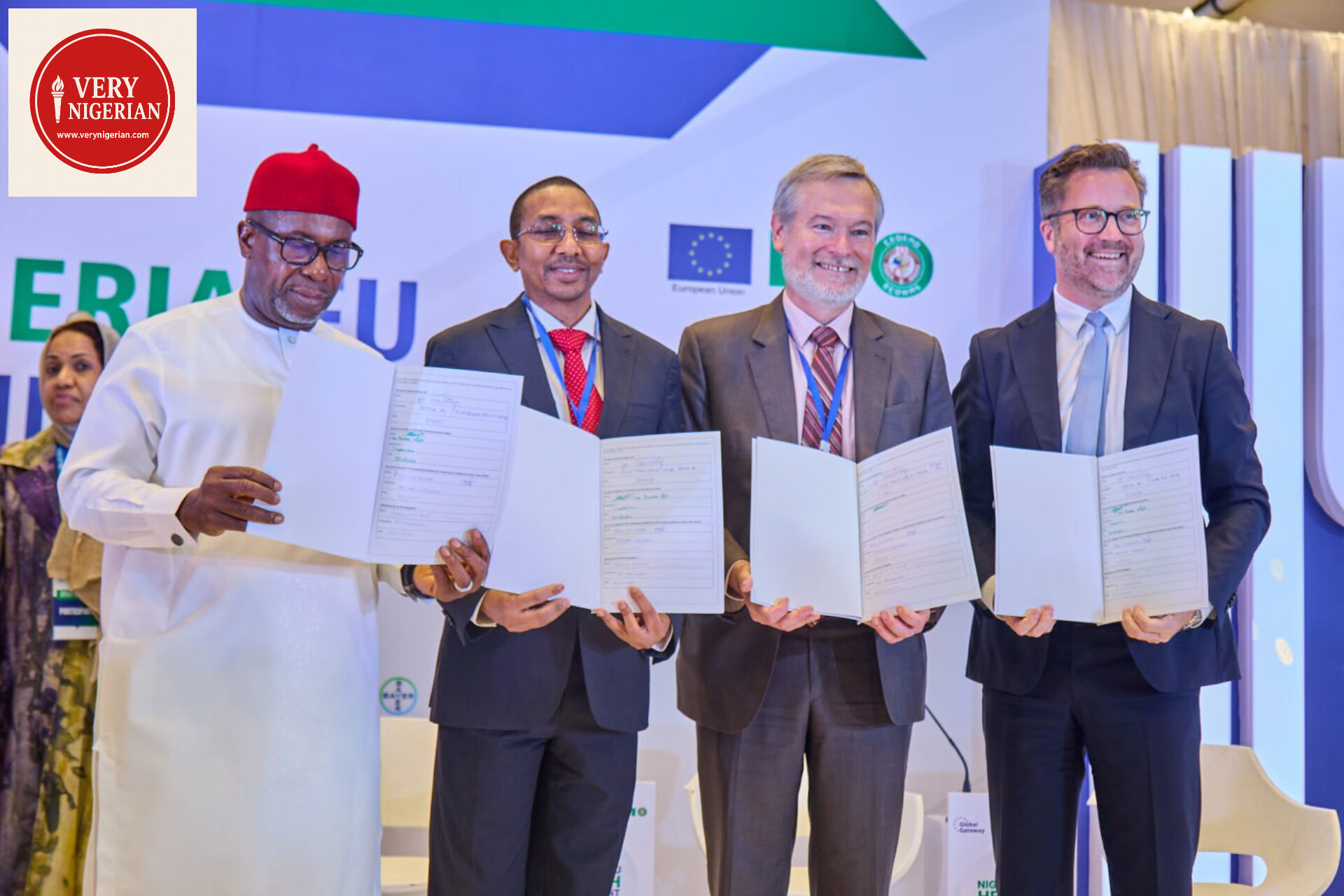
The federal government has signed three landmark agreements with the European Union (EU) and ECOWAS to enhance local manufacturing, attract investment in Nigeria’s pharmaceutical sector, and strengthen reproductive health and rights across West Africa.
The agreements, Enabling Local Manufacturing of Health, Immunisation and Nutrition Commodities in Nigeria (ELM-N), Quality Uplift for Advancing Local Industry in Medicine Standards (Qualimeds Nigeria), and Strengthening Reproductive Health and Rights (SRHR) in West Africa, were signed on Thursday during the Nigeria-EU Health Investment Forum held in Abuja.
The initiative is part of the EU’s Global Gateway Manufacturing and Access to Vaccines, Medicines, and Health Technologies (MAV+) programme, aimed at building a more resilient health ecosystem in Nigeria and the subregion.
Speaking at the event, Vice President Kashim Shettima said the agreements reaffirm the government’s determination to create a sustainable and innovation-driven health economy.
Represented by his Senior Special Assistant on Public Health, Uju Rochas, Shettima said the initiative aligns with President Bola Tinubu’s executive order on local pharmaceutical and medical device production.
“Through the Presidential Initiative for Unlocking the Healthcare Value Chain (PVAC) and frameworks such as the sector-wide approach (SWAp), this administration has taken concrete steps to strengthen health governance, attract investment, and promote local manufacturing,” he said.
“Our message is clear: Nigeria is open for health investment, innovation, and impact. The President has declared that Nigeria’s health transformation will not be driven by aid and dependency alone, but by ownership, accountability, and innovation made in Nigeria, for Nigerians, and by Nigerians.”
Shettima also commended the EU, PVAC, and the National Institute for Pharmaceutical Research and Development (NIPRD) for their collaboration, describing the partnership as “a new chapter defined by shared prosperity, local innovation, and global cooperation.”
EU Ambassador to Nigeria and ECOWAS, Gautier Mignot, said the agreements demonstrate Team Europe’s shared commitment to strengthening health systems through strategic investments.
“Working alongside our partners, including Nigerian authorities, the United Nations, and the private sector, we must build robust, resilient, and efficient health systems to ensure prosperity for all,” he said.
Mignot added that the EU remains a long-standing partner in Nigeria’s health sector, with ongoing support for immunisation, medical research, family planning, and reproductive health initiatives.
“We continue to support Nigeria through our Global Gateway initiatives, particularly reproductive, maternal, and child health, with a €45 million project in Nigeria and nearly €25 million across West Africa,” he said.
He emphasised that the EU aims to shift from aid-based partnerships to “peer-to-peer collaboration” driven by sustainable investment.
Minister of Budget and Economic Planning, Abubakar Bagudu, said the agreements come at a time when Nigeria is implementing reforms to improve healthcare accessibility.
“The absorptive capacity of the Nigerian economy is enormous. We believe both the EU and Nigeria can win together as we build mutual prosperity,” he said.
Also speaking, Minister of Health and Social Welfare, Prof. Muhammad Ali Pate, represented by Olubunmi Aribeana, Director of Food and Drug Services, reaffirmed the government’s commitment to ensuring that locally produced health products benefit both Nigeria and the wider region.
“Local production of health commodities is not merely an economic choice; it is a strategic health security priority,” Pate said.
“By scaling up domestic manufacturing of medicines, diagnostics, vaccines, and other health technologies, we can strengthen universal health coverage and regional self-reliance,” he added.


 Follow Us on Google Discover








2027: Kwankwaso a goat in sheep’s clothing, secretly working for Tinubu – Atiku Campaign Council

DSS arrests Maina’s fugitive son in Abuja, hands him over to EFCC

2027: Step down if you are not working for Tinubu – Deji Adeyanju dares Obi, Kwankwaso

2027: ‘I wont join my Uncle to support Tinubu’ – Davido says

Enugu NYSC death: NAFDAC debunks claims linking corps members death to fake drugs

33 Governors cannot be wrong in supporting Tinubu – Bayo Onanuga

Security forces arrest five suspects over abduction of 20 NYSC members in Imo

Rugby star Hyron Andrews dies at 31 after accidental fall in South Africa

LAUTECH Resident Doctors halt 50-day strike as Makinde intervenes

House Officers, Nurses, Radiographers, Others wanted as DELSUTH opens recruitment – Apply Now

FG raises health fund allocation to N40.76bn, extends insurance to prison inmates

Erisco Foods announces 13 job openings across Nigeria – Apply Now

Tinubu reappoints Bala Bila as INEC commissioner, nominates six others

2027: ‘Don’t trust your destiny to ‘kalokalo’ people’ – Wike warns Rivers voters against Atiku, Amaechi, Obi

BREAKING: Cross River PDP Chairman Venatius Ikem resigns, cites leadership crisis
Erisco Foods announces 13 job openings across Nigeria – Apply Now

2027: Atiku, Obi, Makinde, Adebayo, Duke hold talks with six opposition parties
‘You Betrayed Osun People’ — Adeleke, Davido face backlash over support for Tinubu

Ex-Senator Bello Mandiya’s body found in Abuja home three days after he slipped, hit his head in the bathroom
Tinubu reappoints Bala Bila as INEC commissioner, nominates six others

JUST IN: Finnish Appeal Court reduces Simon Ekpa’s jail term to four years, upholds terrorism conviction

Zamfara govt set to empower 36,176 residents with Dangote shares

Over 10 soldiers, four civilians feared dead as Boko Haram terrorists attack Borno military base

Umahi reopens first Niger bridge after emergency repairs, displays Tinubu’s photos

‘I love Islam, I’ve sent people to Mecca to pray for me, Nigeria for 25 years’ – Akpabio

Lagos govt announces 3-day traffic diversion on Independence bridge for emergency repairs

Elon Musk unveils Tesla’s ‘flying’ car in stunning demonstration

Panic in Rivers community as pipeline explosion injures 20, razes over 50 houses

Tension escalates as thugs attack NDC secretariat in Edo, destroy properties
