
News
‘Nigerian borders are not closed’ – Tunji-Ojo criticises Atiku’s border reopening claims

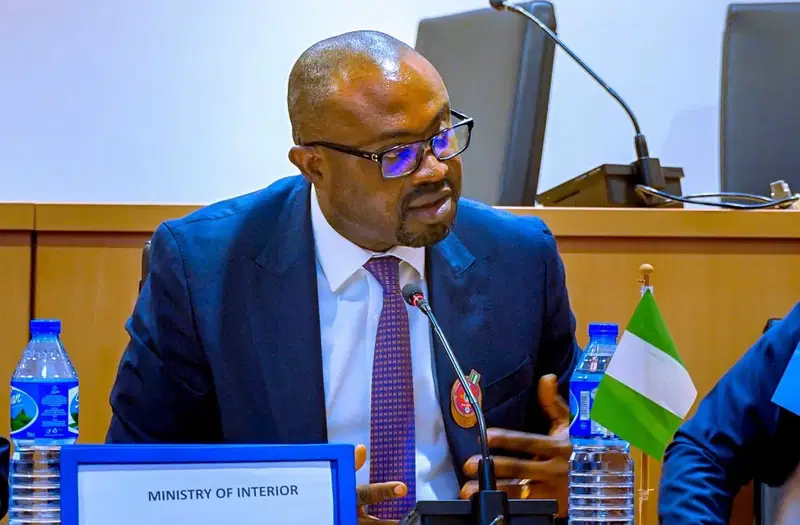
Minister of Interior Olubunmi Tunji-Ojo has criticised former Vice President Atiku Abubakar’s plan to reopen Nigeria’s land borders if elected president in 2027.
Tunji-Ojo argued that the borders cannot be reopened because, contrary to Atiku’s claim, Nigeria’s land borders are not closed.
The minister made the remarks in a statement on Saturday while reacting to Atiku’s comments on his plans for the country’s land borders.
According to Tunji-Ojo, the Nigeria Immigration Service (NIS), which operates under the Ministry of Interior, is responsible for managing Nigeria’s borders and migration.
He explained that the current administration had continued to allow controlled movement of people and goods across the country’s land borders while maintaining proper border management.
Tunji-Ojo’s comments came amid growing political discussions ahead of the 2027 general elections, with Atiku outlining some of the policies he would pursue if elected president.
“As the Minister of Interior who supervises the Nigeria Immigration Service, an agency of government in charge of border and migration management, it is expedient to state that Nigerian borders are not closed and so cannot be reopened,” he said.
Tunji-Ojo recalled that the previous administration reopened four major land borders—Seme, Illela, Maigatari and Mfum—on December 16, 2020, with Idiroko and Ikom subsequently reopened for goods and services on April 20, 2022.
He added that the current administration reopened Kamba and Tsamiya in Kebbi State in February 2026, providing links to Niger Republic and Benin Republic, respectively.
The minister also disputed Atiku’s reference to the borders with Cameroon, Chad, Niger and Benin Republic as having been subjected to prolonged closure because of the 2019 trade policy.
According to him, the situation along the Cameroon border, particularly at Banki and Amchidé, was driven by security concerns arising from the Boko Haram insurgency.
“The prolonged closures on the Cameroon border, at Banki and Amchidé, did not arise from the 2019 trade policy at all. They date to 2014, when Boko Haram forced their closure for security reasons,” Tunji-Ojo said.
He explained that the crossings were reopened in 2019, while Fotokol and Gambaru followed in 2021 after joint military and stabilisation efforts by Nigeria, Cameroon, Niger and Chad.
“Folding this separate, security-driven history into one continuous 2019 shutdown misrepresents two distinct issues, trade regulation and counter-insurgency, as a single failure,” he said.
Tunji-Ojo acknowledged that some northern crossings were not yet operating without restrictions, attributing the situation to continuing security challenges in some areas.
“Not every northern crossing is fully unrestricted today. Where banditry or residual insurgent activity persists, tighter control is a deliberate security judgement, not neglect,” he said.
He warned that reopening border crossings ahead of improvements in the security situation could expose traders and border communities to greater risks.
The minister argued that effective border management should combine security, documentation, customs compliance and trade facilitation, rather than being based on either complete closure or unrestricted movement.
“Modern border management is not a choice between total closure and unrestricted movement; it requires security, documentation, customs compliance and controlled trade facilitation together,” he said.
Tunji-Ojo also challenged Atiku to provide details of his proposed border policy if elected president, rather than presenting the country’s trade, security and infrastructure challenges as a single issue.
“If he has a new border proposal, he should set it out and explain how it differs from the current approach, rather than treating separate trade, security and infrastructure issues as one and the same,” the minister said.
He further cautioned against using political competition to alter the account of recent developments in Nigeria’s border management.
“Political competition should not become a competition to rewrite recent history,” Tunji-Ojo said.
Atiku, who has sought to become President in six election cycles since 1993, had also proposed the development of seaports in the South-South and South-East to address what he described as an imbalance in Nigeria’s import and transportation infrastructure.
During his campaign for the 2023 presidential election, which he lost, Atiku said he had held discussions with shippers and ship-development companies in Europe to seek their support for developing ports in the South-South and South-East.
Nigeria’s busiest seaports are concentrated in Lagos, while coastal states such as Akwa Ibom and Bayelsa also have access to the Atlantic Ocean.


 Follow Us on Google Discover





Sowore drags DSS, DG, AGF to Court, demands N5bn over alleged assault, abduction

Benue: Catholic Diocese orders closure of schools, hospital following repeated attacks

2027: ‘There is no rift between Wike and APC governors, both sides are united’ – Morka reveals

NNPC records N431bn profit as revenue rises to N3.74tn in August

INEC sets October 24 deadline for parties to challenge missing 2027 candidates

Viking stun Bayern Munich with thrilling 3-3 draw in Champions League

Arsenal hit Lille for three in seven minutes to maintain perfect Champions League start

Lookman scores as Atletico Madrid beat Manchester United 2-0 in Champions League

Super Falcons Thrash Comoros 5-0, advance to Third Round of Olympic qualifiers

Pope Leo XIV undergoes successful lung surgery at Rome hospital

Shell exits Nigeria gas distribution business in deal with Vaaris Energy

Tinubu seeks Senate’s approval of five bills on drug enforcement, safety, others

Osimhen, Lookman face Champions League tests against Barcelona, Man United

Digital Postcode: How to check your address, correct errors online

Reps back PINL contract renewal, seek dismissal of petition over lack of evidence

Dangote Group opens 86 vacancies in Engineering, Finance, Logistics, HR, other fields

ECOWAS Bank opens applications for 2026 Young Professionals Programme

BREAKING: Police arrest former Imo governor Rochas Okorocha in Abuja

BREAKING: APC revises Tinubu Campaign Council, names Wike, Adeleke, Soludo as FCT, Rivers, Osun, Anambra coordinators (Full List)

Christopher University announces staff recruitment for academic, administrative positions

Obafemi Awolowo University (OAU) opens 51 non-academic job vacancies in healthcare, other sectors – Apply Now

Names of 68 lawyers elevated to SAN rank (Full list)

2027: Economic hardship, appointments threaten Tinubu’s support in Northern Nigeria

Ex-Akwa Ibom University SUG President dies at Enugu NYSC camp

INEC disowns fake notice on six states as parties seek candidates’ inclusion

Ayra Starr makes African history, headlines NFL international game halftime show in London

JUST IN: Segun Ogunwuyi steps down as Makinde’s chief of staff

‘Tinubu Must Go’ – He’s planning to obtain fresh $20bn loan for Coastal Highway project – Atiku

FG receives 105 Nigerians rescued in Ghana cybercrime crackdown
