
Politics
‘Politics Is Not Madness’: Emir of Katsina warns Tinubu Campaign DG Yari

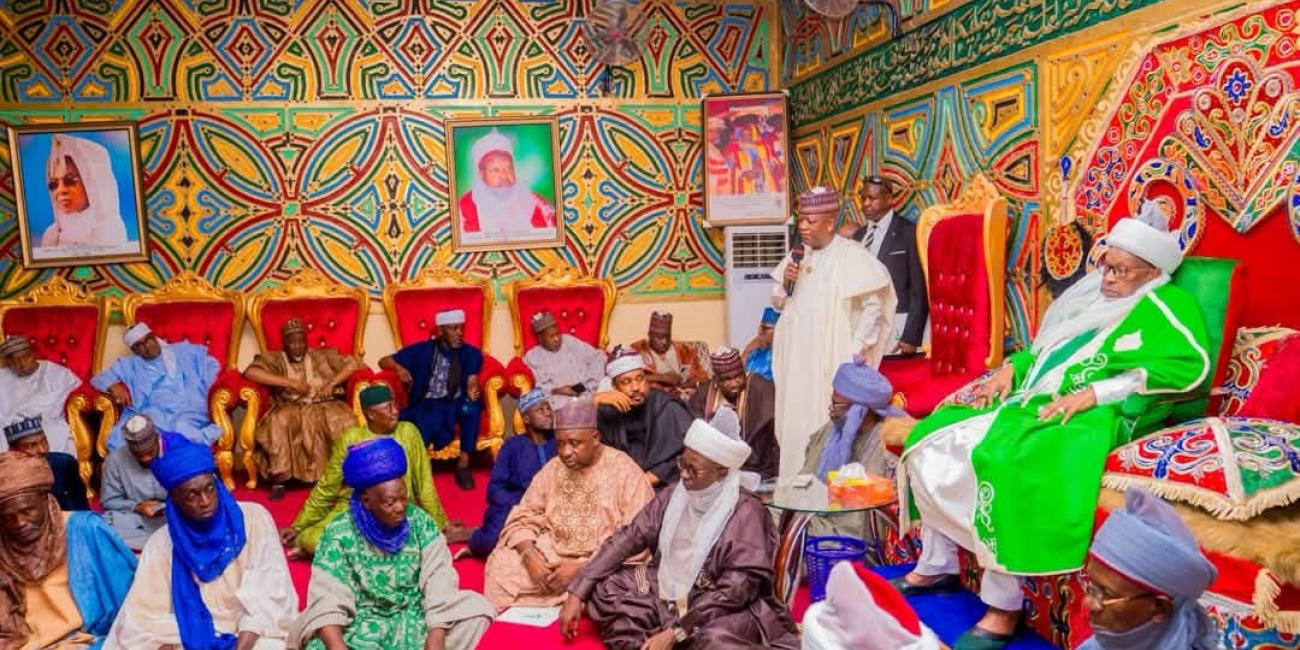
The Emir of Katsina, Alhaji Abdulmumini Kabir Usman, has cautioned Senator Abdulaziz Abubakar Yari, Director-General of the All Progressives Congress (APC) Presidential Campaign Council for President Bola Tinubu’s 2027 re-election bid, against misleading Nigerians, urging political leaders to prioritise security, economic welfare and the needs of ordinary citizens.
The monarch also declared that “politics is not madness”, calling on politicians to abandon dishonesty, hatred, envy and attempts to undermine others for political advantage.
The Emir made the remarks when Yari visited his palace in Katsina State earlier this week. His comments were captured in a Hausa-language video seen by SaharaReporters.
During the interaction, the monarch expressed concern over the worsening security situation in parts of northern Nigeria, particularly the difficulties faced by farmers who can no longer access their farmlands because of insecurity.
He also lamented the decline of economic and industrial activities in the region, urging political leaders to focus on addressing the challenges rather than pursuing personal interests and political rivalries.
Addressing Yari, the Emir said the responsibility of political leadership extended beyond Katsina to the entire country, stressing that those in positions of authority must stand for the truth.
“Director-General, you are now in a position of leadership. This is not just about this place; it concerns the entire country. We are all children of this nation, and we must stand for the truth,” he said.
The monarch urged Yari to convey his message to other political leaders and influential figures, emphasising that leadership should be driven by compassion and service to the people.
“I swear to God, unless you love people, help them and work with them, you cannot expect Allah to love you, stand by you and help you,” he added.
‘Politics Is Not Fighting or Condemning Others’
The Emir stressed that political engagement should be based on persuasion, dialogue and respect for differing opinions rather than confrontation, insults and personal attacks.
“Yes, politics, it must be about politics. What is politics? You convince me to accept your conviction,” he said.
“You must be wise enough to listen to what I have to say or consider my point of view. That is politics. It is not fighting or condemning others.
“It is not about backbiting, envy or malice.”
He reminded politicians that public support comes with the responsibility to respect citizens, listen to their concerns and work towards improving their welfare.
The monarch also drew on religious teachings, noting that the Quran and the Bible emphasise the importance of putting the interests of others before personal gains.
However, he lamented what he described as a decline in these values within political life, accusing some individuals of concentrating on undermining opponents rather than working for the common good.
He questioned why political rivalry had increasingly become associated with efforts to destroy other people’s livelihoods and prevent them from earning a living.
The Emir warned that those who treat others with contempt should not assume they would never face similar treatment.
“Whoever you are, I repeat, whoever you are, if you treat another person with contempt, I swear to God, you will eventually experience something you do not like,” he said.
Emir Condemns Dishonesty in Politics
The monarch also spoke against what he described as deliberate dishonesty in political engagements, insisting that politicians should not misrepresent events or make false claims to win public support.
While acknowledging that Islamic teachings recognise limited circumstances in which deception may be permitted, including reconciliation and certain situations during warfare, he argued that such exceptions should not be used to justify dishonesty in ordinary political dealings.
“Come, let me explain something to you. There are circumstances in which lying is permissible: for example, to preserve harmony between a husband and his wife, or to reconcile people and prevent further conflict,” he said.
He added that certain forms of strategic deception might be permitted during warfare but maintained that politicians should not fabricate events or deliberately mislead people in their everyday dealings.
“But lying in this manner, when you come to me and claim something happened when you know it did not, is unacceptable. May Allah guide us to what is right, I swear to God,” he said.
The Emir reiterated that truthfulness should guide the conduct of public officials regardless of their political ambitions or affiliations.
“As for me, wherever I go, whenever I open my mouth, I speak the truth. I have said this based on the Holy Quran,” he added.
Insecurity Preventing Farmers From Accessing Farmlands
The Emir expressed concern over the impact of insecurity on farming communities in northern Nigeria, saying threats to lives and livelihoods had prevented some farmers from carrying out their activities.
“Why are we drifting apart? Farmers have been prevented from carrying out their activities,” he said.
He challenged political leaders to address the situation, warning that insecurity was affecting ordinary citizens and undermining economic activities across affected communities.
The monarch also questioned the decline of major industrial establishments in Kaduna State, citing the DIC and Peugeot company as examples of businesses whose present conditions should concern regional leaders.
“If you go to Kaduna, look at the DIC and the Peugeot company. Where are they now? They have all collapsed. Why?” he asked.
He expressed disappointment that influential figures in the region had not done enough to speak out about the challenges confronting their communities.
“And we have remained silent. Who are the elders?” he asked.
“We have to speak. We have to speak. We must stand up and take action.”
The Emir urged traditional rulers, political leaders and other influential Nigerians to use their positions to demand solutions to insecurity, economic decline and the difficulties preventing citizens from earning a living.
He maintained that leadership should be measured by its impact on people’s lives rather than status, wealth or access to political power.


 Follow Us on Google Discover








Police allegedly invade hospital owned by ex-Super Eagles star Emenike after he criticized Imo Governor

‘Politics Is Not Madness’: Emir of Katsina warns Tinubu Campaign DG Yari

Terrorism: Court sentences Gana’s spy to 40 years in prison for aiding Benue militia leader

Police arrest man over Lexus SUV with concealed ‘presidency’ number plate in Abuja

Ebola: FG bars 46 contacts of infected patient from air travel for 21 days

Bandits intercept vehicle in Sokoto, gun down all passengers

Bauchi Imam removed from position for allegedly campaigning for Tinubu’s second term

Dele Giwa: Forty Years after the parcel that shook Nigeria: by Shu’aibu Usman Leman

Ebola: ‘We’re on top of the situation’ — Tinubu Govt urges Nigerians not to panic

Momodu says Atiku has more national experience than Tinubu, Obi

FEC approves four new companies to overhaul Nigeria’s seaport operations

2027: He is a ‘wole wole’ man – APC National Secretary questions Atiku’s ability to fix Nigeria’s economy

‘Explain how N10bn Ebola preparedness fund was spent’ – Atiku tackles Tinubu

2027: FRSC bans personnel from escorting politicians during campaigns

Ebola patient arrived in Abuja on October 3 aboard Ethiopian airlines flight ET333 – Source

Proten International opens 18 job positions across states in Nigeria

TeamAce announces 64 job openings across Nigeria, with salaries up to ₦2 Million – Apply Now

R & R recruitment announces 31 job openings across Nigeria – Apply Now

BREAKING: FG reports confirmed Ebola case in Abuja, identifies 44 contacts for tracing

Senate approves Sani Ndanusa’s appointment as ambassador-designate

Delta govt declares three days of mourning for Former Governor Uduaghan

History and service have kept us intertwined – Tinubu celebrates Kwankwaso at 70

Seven-year-old boy found dead after suspected kidnappers demand N2.5m ransom in Plateau
2027 Election: Court rejects suit to compel INEC to register new party

‘Where is my house?’ – Ortom questions Alia over denial of ex-governor’s benefits

Tinubu meets NELFUND Chairman Jim Ovia at Aso Rock

Reps launches investigation into Corps member’s death at Enugu camp

Toluwanisings: Family announces night of tributes, service of songs for late gospel singer

Oyebanji appoints four officials, swears in SSG, chief of staff in Ekiti
