
World
UN greenlights transitional administration for Gaza, sets roadmap for Palestinian statehood

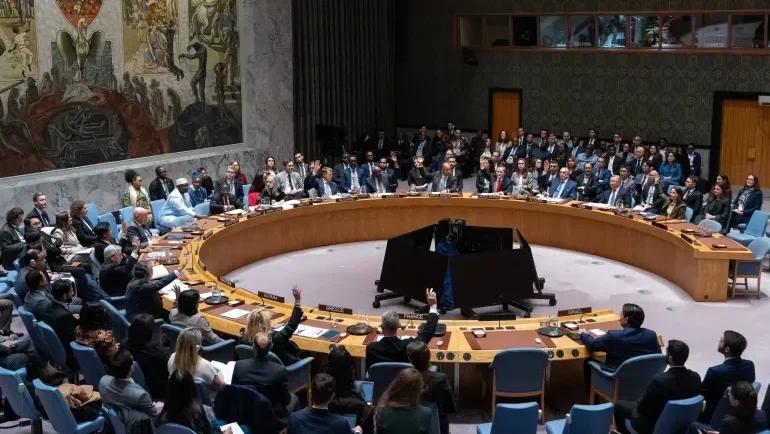
The United Nations Security Council has approved a significant resolution mandating a transitional administration and an International Stabilisation Force in Gaza, establishing what the document describes as a “credible pathway” to Palestinian statehood.
The resolution, drafted by the United States as part of President Donald Trump’s 20-point peace plan, was adopted on Monday with a 13-0 vote. Russia and China abstained.
Arab and Muslim-majority nations, many of which had indicated willingness to contribute troops to a stabilisation force, insisted on a UN mandate before taking part. To secure their support, Washington added clearer language on Palestinian self-determination, allowing the deal to move forward.
The revised draft now states that “conditions may finally be in place for a credible pathway to Palestinian self-determination and statehood,” provided the Palestinian Authority undertakes internal reforms and progress is recorded in Gaza’s reconstruction.
However, this wording immediately drew criticism from Israeli Prime Minister Benjamin Netanyahu, who reiterated his government’s opposition to a Palestinian state and vowed to demilitarise Gaza “the easy way or the hard way.”
Israel’s National Security Minister Itamar Ben-Gvir went further, calling for the assassination of Palestinian Authority officials if the UN supports Palestinian statehood.
US Ambassador to the UN Mike Waltz welcomed the adoption of the resolution, saying it marked “another significant step that will enable Gaza to prosper in an environment that will allow Israel to live in security.”
Algeria’s envoy, Amar Bendjama, praised Trump’s role in securing a ceasefire but insisted that lasting peace would require justice for Palestinians “who have waited for decades for the establishment of their independent state.”
According to the resolution, stabilisation troops will secure border areas in partnership with a trained Palestinian police force and coordinate with neighbouring countries to ensure humanitarian aid reaches Gaza. The force is also mandated to oversee the “demilitarisation of the Gaza Strip” and the “permanent decommissioning of weapons from non-state armed groups,” with authorisation to use all necessary measures.
Hamas swiftly rejected the resolution, arguing that it undermines Palestinian rights and imposes an international trusteeship on Gaza. The group said that giving foreign forces authority inside Gaza—particularly the mandate to disarm resistance factions—removes neutrality and “turns it into a party to the conflict in favour of the occupation.”
The resolution outlines that Israeli troops would withdraw from Gaza based on specific “standards, milestones and timeframes linked to demilitarisation,” to be agreed by the stabilisation force, Israel, the US and ceasefire guarantors.
Reacting on his Truth Social platform, Trump said the international board overseeing Gaza would include “the most powerful and respected Leaders throughout the World,” and thanked Qatar, Egypt, the UAE, Saudi Arabia, Indonesia, Türkiye and Jordan for backing the effort.
Meanwhile, Russia presented a rival draft emphasising the need for Gaza and the occupied West Bank to form a single contiguous Palestinian state under the Palestinian Authority, and calling for a strengthened Security Council role in guaranteeing Gaza’s security and implementing the ceasefire.


 Follow Us on Google Discover

BREAKING: Tinubu extends tenure of NCoS, Immigration service chiefs until 2028

Portugal hands Ronaldo 30-Day suspension, €255 fine for walking out of camp

Wike’s son Jordan dragged to EFCC over alleged $2.1m land fraud

Subsidy removal is here to stay, ‘we will never go back to Egypt’ – Tinubu

If Buhari a General could not end insecurity, you cannot blame Tinubu – Yari

Sanwo-Olu reportedly demands LAWMA boss’ resignation over mounting refuse in Lagos

Gregory University founder Gregory Ibe dies at 63

Abia: NAFDAC uncovers suspected N500m fake alcohol factory in Aba

Veteran journalist Christiane Amanpour set to exit CNN after four decades

Gov Otti signs four bills into law, introduces criminal justice reforms in Abia

Pandemonium as fuel tanker goes up in flames under Lagos’ Otedola bridge

FG to introduce fuel taxes when economy stabilises, Oyedele says

10 key facts about late former Delta Governor, Emmanuel Uduaghan

Bauchi NDC governorship candidate Ibrahim Kashim resigns from party

Court throws out El-Rufai’s fundamental rights suit against DSS, ICPC, EFCC
BREAKING: Former Delta Governor Emmanuel Uduaghan is dead

‘₦29,000 Cannot sustain a retired officer’ — Atiku challenges Tinubu on police pensions, proposes initiative

Opposition will front a single candidate against Tinubu, announcement will be made few days to election – Lukman

Eight Nigerian Soldiers killed as ISWAP landmine hits Army patrol vehicle in Borno

2027: Tinubu must be stopped, ‘even Buhari saw him as bad news’ — Hakeem Baba-Ahmed
Bauchi NDC governorship candidate Ibrahim Kashim resigns from party

2027: “Which North? North Korea or North Carolina?” Nigerians mock politicians promising Tinubu Northern votes

2027: NDC will never step down for Atiku, stop attacking us – Kwankwaso replies ADC Campaign Council

Messi’s double fires Inter Miami to 3-1 victory over Atlanta United

Catholic priest dies after Jesus’ statue falls on him during mass in Ecuador (video)

“I saw Akpabio at the State House begging Tinubu to keep his position” — Jake Epelle

FG defends fiscal reforms as World Bank flags ₦7.7tn debt interest

Wike, Akpabio, Uzodimma: Unity at the podium, rival ambitions behind the Scenes? can Tinubu keep his associates together?

‘Nigeria cannot become prosperous in four years’ — Tinubu’s Economic Adviser says