National News
FG turns to Deutsche Bank for $5bn loan as Middle East tensions stall UAE deal

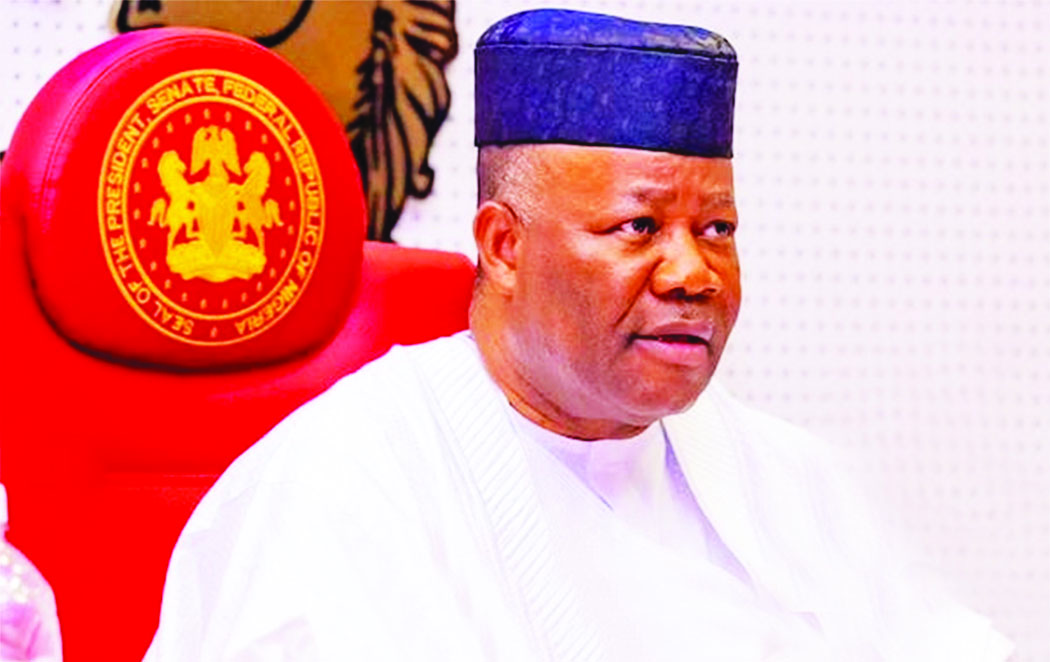
President of the Senate, Godswill Akpabio, has disclosed that Nigeria’s plan to secure a $5 billion loan from the United Arab Emirates has been delayed due to ongoing geopolitical tensions involving the United States, Israel, and Iran.
Akpabio made the revelation during plenary as the Senate considered and approved a $516.3 million loan request by President Bola Tinubu for the construction of the Sokoto–Badagry Superhighway.
He explained that the instability in the Middle East disrupted the Federal Government’s borrowing arrangement with Abu Dhabi Bank, necessitating urgent alternative funding to sustain critical infrastructure projects.
According to him, the Senate fast-tracked approval of the $516 million facility to ensure that key national projects are not stalled.
Earlier, Chairman of the Senate Committee on Banking, Insurance and Other Financial Institutions, Adetokunbo Abiru, also highlighted the difficulties encountered in securing the planned UAE facility.
President Tinubu had, in March, written to the Senate seeking approval to borrow $5 billion to finance the 2026 budget deficit and support key government obligations.
With delays in accessing the UAE funds, the Federal Government turned to Deutsche Bank, securing a $516.3 million syndicated loan for the Sokoto–Badagry Superhighway project.
The Senate subsequently approved the facility after adopting the report of its Committee on Local and Foreign Debts, chaired by Aliyu Wamakko.
The loan is backed by a partial risk guarantee from the Islamic Corporation for the Insurance of Investment and Export Credit, an arm of the Islamic Development Bank.
In his communication to lawmakers, Tinubu said the Federal Government would provide N265.5 billion as counterpart funding for land acquisition, compensation, and related infrastructure.
He explained that the proposed highway, spanning about 1,000 kilometres from Illela in Sokoto State to Badagry in Lagos State, is designed to connect seven states and boost economic activities along the northwest–southwest corridor.
According to the President, the project is expected to improve connectivity, reduce logistics costs, enhance road safety, facilitate trade, strengthen food security, and promote national integration.
Lawmakers, including Deputy Senate President Barau Jibrin and Chief Whip Mohammed Monguno, commended the administration’s efforts, describing the initiative as a strategic intervention to drive economic growth despite prevailing global uncertainties.


 Follow Us on Google Discover





Dr. Benjamins‑Laniyi urges media to amplify women’s leadership, adopt gender‑sensitive reporting

Pope Leo XIV set to leave hospital after lung cancer surgery

Gunmen kill four vigilantes in Plateau community

Tension as traditional ruler collapses, dies in Ondo

2027: Kwankwaso a goat in sheep’s clothing, secretly working for Tinubu – Atiku Campaign Council

DSS arrests Maina’s fugitive son in Abuja, hands him over to EFCC

2027: Step down if you are not working for Tinubu – Deji Adeyanju dares Obi, Kwankwaso

2027: ‘I wont join my Uncle to support Tinubu’ – Davido says

Enugu NYSC death: NAFDAC debunks claims linking corps members death to fake drugs

33 Governors cannot be wrong in supporting Tinubu – Bayo Onanuga

Security forces arrest five suspects over abduction of 20 NYSC members in Imo

Rugby star Hyron Andrews dies at 31 after accidental fall in South Africa

LAUTECH Resident Doctors halt 50-day strike as Makinde intervenes

House Officers, Nurses, Radiographers, Others wanted as DELSUTH opens recruitment – Apply Now

FG raises health fund allocation to N40.76bn, extends insurance to prison inmates

Erisco Foods announces 13 job openings across Nigeria – Apply Now
‘You Betrayed Osun People’ — Adeleke, Davido face backlash over support for Tinubu

Ex-Senator Bello Mandiya’s body found in Abuja home three days after he slipped, hit his head in the bathroom

Tinubu reappoints Bala Bila as INEC commissioner, nominates six others
House Officers, Nurses, Radiographers, Others wanted as DELSUTH opens recruitment – Apply Now

‘I love Islam, I’ve sent people to Mecca to pray for me, Nigeria for 25 years’ – Akpabio

Over 10 soldiers, four civilians feared dead as Boko Haram terrorists attack Borno military base
2027: Step down if you are not working for Tinubu – Deji Adeyanju dares Obi, Kwankwaso

Umahi reopens first Niger bridge after emergency repairs, displays Tinubu’s photos

Panic in Rivers community as pipeline explosion injures 20, razes over 50 houses

Elon Musk unveils Tesla’s ‘flying’ car in stunning demonstration

2027: Tinubu to miss rallies in over 20 States as APC releases campaign timetable

Tension mounts as NLC rejects FG’s response to 14-day ultimatum

‘No plan to raise electricity tariff’ – FG assures Nigerians
