Editorials
Kidneys for Cash: The disturbing story behind Abuja’s organ-harvesting network

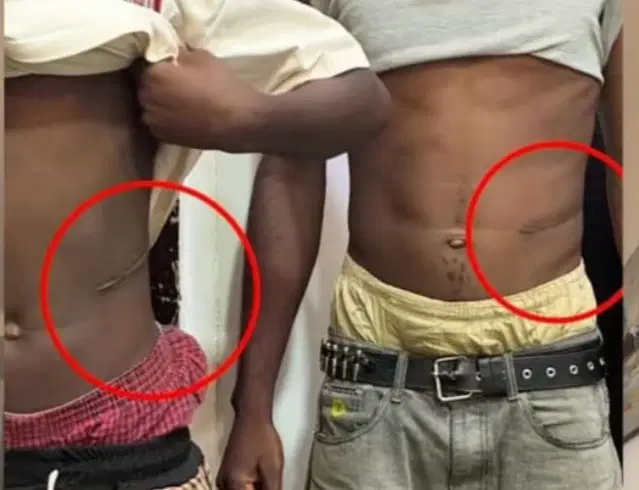
The disturbing allegations surrounding an alleged organ-harvesting syndicate operating around Abuja and Nasarawa State have taken a more troubling turn following the account of a young Nigerian, Samuel Ezekiel, who said he was deceived into undergoing kidney removal after his identity was allegedly changed.
Ezekiel, who was among those whose accounts have emerged in connection with the investigation, alleged that his friend, Emmanuel Udeh, took advantage of his trust, arranged his movement to a hospital and facilitated the change of his name to “Hassan Abubakar” before he underwent surgery at Wellington Hospital, Life Camp, Abuja.
He further alleged that after he was paid in United States dollars for the procedure, he handed the money to Udeh for safekeeping. According to him, Udeh later changed the dollars and used part of the proceeds to purchase electronic devices, including two phones, two power banks and two Wi-Fi devices.
Ezekiel made the allegations on Friday while speaking to journalists during the Nigeria Police Force parade of suspects linked to an alleged organ-harvesting network operating in Abuja and Nasarawa State.
How the ordeal allegedly began
According to Ezekiel, the ordeal began when Udeh told him they were going to a hospital.
He said he trusted his friend and therefore followed his instructions without fully understanding what was being arranged.
“It’s my friend that deceived me. His name is Emmanuel Udeh,” Ezekiel said.
He explained that Udeh subsequently connected him with another man identified as David, who took him to an agent named Ben for medical tests.
The initial test, according to Ezekiel, did not match the medical requirements of the intended kidney recipient. He said the agent later informed them that another recipient had been found.
Ezekiel said he was subsequently told that his kidney matched another person.
It was at that point, he alleged, that he was informed that his identity would be changed.
“Then he now said that they are going to change my name, that I will be bearing Hassan Abubakar,” he said.
He said the group later took him to the Federal High Court, where an affidavit was prepared using the new identity.
“Then from there, they now took us to the Federal High Court, where they did the affidavit. Then from there, we now went to the hospital, Wellington Clinic,” he said.
At the hospital, Ezekiel said documents were signed before he was eventually taken into the theatre.
The dollars and the electronic devices
One of the most striking aspects of Ezekiel’s account was his description of what happened to the money he allegedly received.
He said the money was brought to them late at night, shortly before he entered the theatre.
“After we sign, then later in the night around 10:00 to 11:00, they now come and give us, uh, money in dollars,” he said.
According to him, he handed the money to Udeh because he trusted him to keep it.
“After they give us the money, then when I wanted to enter the theater, I gave Emmanuel the money to hold it,” he said.
But when he emerged from the theatre, he alleged that Udeh had already changed the money.
“After I gave him the money, when I came out from the theater, then later in the evening, Emmanuel came back. He had already gone and changed the money,” Ezekiel said.
He alleged that Udeh used part of the proceeds to purchase two phones, two power banks and two Wi-Fi devices.
“He bought two phones, two power banks, and two Wi-Fi. Then he now gave me one and held one. Everything he bought, he gave me one and held one,” he said.
Ezekiel said they remained at the hospital for approximately one week before they were discharged.
Udeh then allegedly took him to a hotel, where they spent another two days.
The journey, he said, did not end there.
From Abuja to Cross River
After their stay at the hotel, Ezekiel alleged that Udeh took him to Cross River State, where they remained for about three months.
“After the hotel, we spent two days, and then he now took me to his state in Cross River. We spent almost like three months in Cross River,” he said.
It was during that period, according to him, that he eventually asked about the money he had received.
His account was that Udeh told him the money had already been exhausted.
“Before I asked him, ‘Where is the money?’ He told me that the money had finished,” Ezekiel said.
He further alleged that Udeh later told him they had no money to return to Abuja.
According to Ezekiel, Udeh eventually took his phone and sold it to raise money for transportation.
“Then he said that we don’t have transport for coming back. He collected my phone and sold it. Then that is how we had transport and came back to Abuja,” he said.
Did he know his kidney would be removed?
Ezekiel’s account raises another important question: whether he understood that he was going to lose a kidney.
He acknowledged that he had been told that his kidney would be removed, but said Udeh reassured him that the procedure would not negatively affect his life.
“He just told me that it’s something that they will just, uh, convert it, that there’s not any issue in there, that if they convert it, I can do everything that I want to do, that I will not have any issue,” he said.
Ezekiel confirmed that he consented to the procedure, which he said was carried out at Wellington Hospital, Life Camp, on April 24.
He also confirmed that he was paid in dollars, although he could not establish the exact amount.
Asked how much he received, he recalled several $100 notes and one $50 note.
“It’s 100, 100 dollars with one 50 dollar,” he said.
His inability to state the exact amount leaves the precise value of the alleged payment unclear.
Police investigation widens
Ezekiel’s account came as the Nigeria Police Force intensified investigations into an alleged organ-harvesting syndicate believed to have operated around Abuja and Nasarawa State.
The police on Friday paraded several suspects following a sting operation in the Auta Balefi area of Karu Local Government Area of Nasarawa State.
Among those paraded was Emmanuel Udeh, whom the police accused of recruiting victims for the alleged organ-harvesting network.
Also paraded were Dr Benjamin Oyime, a nephrologist and consultant to Wellington Hospital; Dr Daniel Otukpa, another nephrologist and Acting Director of Clinical Services at the hospital; and David Idoko.
The police alleged that the syndicate targeted vulnerable young people and facilitated illegal kidney removal through forged documents and false representations.
The Force said investigations were continuing and that efforts were being made to identify and arrest other members of the alleged network.
At this stage, the allegations remain subject to investigation and due process.
How the allegations came to public attention
The case became widely known after social media activist Martins Otse, popularly known as VeryDarkMan, disclosed that a young man had approached his organisation with medical evidence indicating that his left kidney was missing.
The disclosure prompted calls for investigation, after which the police commenced inquiries that eventually led to the arrest and parade of suspects.
A lawyer to VeryDarkMan, Abubakar Marshal, subsequently provided additional details in a televised interview monitored by Vanguard.
Marshal alleged that the affected young man was paid approximately $1,300 following the kidney-removal procedure, which he said was equivalent to about N1.5 million at the time.
According to him, the young man first approached the Martins Vincent Center initiative, known as MRI, headed by VeryDarkMan, with allegations that his left kidney had been removed.
Marshal said the organisation initially questioned the claim and asked the young man to obtain medical evidence.
He said the young man later returned with a medical report showing the absence of his left kidney.
“We went to two separate hospitals in Abuja, a reputable private hospital and another government hospital, which is the Federal Medical Centre in Jabi, Abuja, where it was confirmed that indeed, the young man’s left kidney had been removed,” Marshal said.
Alleged payment and identity change
Marshal further alleged that the young man was paid about $1,300 after the alleged kidney harvesting.
He claimed the payment was made to persuade the young man to remain silent.
According to him, the young man’s identity was subsequently changed through an affidavit, allegedly as part of an attempt to conceal the transaction.
Marshal also alleged that the young man developed complications about a month after the procedure, including pus reportedly coming from the area around his left side.
The lawyer said the case could represent part of a broader pattern involving vulnerable young people in the Federal Capital Territory.
He alleged that several young men around Karu, Nyanya and Mararaba had either come forward or were being identified in connection with similar cases.
“Most of those boys around Karu, Nyanya, Mararaba axis, a lot of them are engaged in this unlawful (practice),” he alleged.
Marshal further claimed that some hospitals and their agents allegedly targeted young men facing financial difficulties and persuaded them to undergo kidney removal.
He alleged that while some donors were paid relatively small sums, kidneys were allegedly sold to recipients for millions of naira.
“Some of these donees, which these hospitals sold some of these kidneys to, pay as high as N50 million to N70 million,” he claimed.
Those claims have not been independently verified.
Where lawful organ donation ends and criminal exploitation begins
Marshal stressed that organ transplantation itself is not illegal in Nigeria.
The issue, he argued, is whether the process complies with the country’s legal requirements, particularly regarding informed consent, financial inducement and the proper procedures governing organ donation.
“For the donation of an organ to be lawful, there must be informed consent of an adult person. There must also be no form of financial inducement,” he said.
He cited the National Health Act and the Trafficking in Persons (Prohibition) Enforcement and Administration Act as part of the legal framework governing the issue.
The distinction is critical.
There is an important difference between a lawful medical donation carried out with genuine informed consent and an arrangement in which vulnerable people are allegedly deceived, coerced, financially exploited or subjected to procedures through falsified identities or documents.
The allegations now before the police therefore demand a thorough investigation—not only into the individuals already arrested, but also into the medical, financial and administrative processes surrounding the alleged procedures.
Questions that demand answers
The emerging accounts raise serious questions that investigators must answer.
How was a person allegedly able to obtain a new identity through an affidavit for the purpose of a medical procedure?
Who prepared and processed the documents?
How was the alleged recipient identified?
Who recruited the young man?
Who authorised the medical procedure?
What amount was actually paid?
Where did the money come from, and to whom was it ultimately paid?
Were all required medical and legal approvals obtained?
And if the allegations of a wider network are established, how many other vulnerable Nigerians may have been affected?
These questions go beyond the fate of one young man.
They touch on the integrity of Nigeria’s healthcare system, the protection of vulnerable citizens and the ability of regulatory agencies to prevent the exploitation of poverty.
Parents allegedly kept in the dark
Marshal also alleged that the parents of the affected young man were not involved in the procedure and only became aware of the matter after complications and allegations surrounding the kidney removal emerged.
“No family member of this young man was involved. None of their parents were involved. It was after the entire thing turned around and became an issue that their parents got involved and their parents got to know,” he said.
If established, such circumstances would raise even more serious questions about the validity of consent and the safeguards surrounding organ donation.
The larger danger
The most disturbing element of the allegations is the possibility that poverty could be exploited as a gateway into an illegal organ market.
Young people struggling financially may be particularly vulnerable to promises of quick money. Where criminal networks allegedly combine such vulnerability with false assurances, forged documents and medical access, the consequences can be devastating.
A kidney is not simply another commodity that can be exchanged for money. Its removal carries lifelong implications and therefore demands the highest standards of medical ethics, informed consent and legal protection.
The police investigation must consequently be allowed to run its full course.
Those arrested are entitled to due process and must not be convicted in the court of public opinion. At the same time, the seriousness of the allegations requires investigators to follow the evidence wherever it leads.
If the allegations are substantiated, everyone involved—recruiters, facilitators, medical practitioners, document handlers, financiers and any other accomplices—should face the full consequences of the law.
If some allegations prove unfounded, that too should be established transparently.
What Nigeria cannot afford is for a case involving the alleged removal of human organs to disappear into the familiar cycle of outrage, headlines and silence.
The investigation must establish the truth, protect victims, expose any criminal network and strengthen the safeguards necessary to ensure that no vulnerable Nigerian is ever again deceived into surrendering a vital part of his body under circumstances he does not fully understand.
For now, the accounts of Samuel Ezekiel, the allegations made by Abubakar Marshal and the claims contained in the police investigation remain allegations.
The final responsibility lies with the relevant authorities to establish, through credible evidence and due process, exactly what happened at Wellington Hospital and whether a wider organ-harvesting network operated around Abuja and Nasarawa State.


 Follow Us on Google Discover

LAUTECH Resident Doctors halt 50-day strike as Makinde intervenes

House Officers, Nurses, Radiographers, Others wanted as DELSUTH opens recruitment – Apply Now

FG raises health fund allocation to N40.76bn, extends insurance to prison inmates

Erisco Foods announces 13 job openings across Nigeria – Apply Now

Tinubu reappoints Bala Bila as INEC commissioner, nominates six others

2027: ‘Don’t trust your destiny to ‘kalokalo’ people’ – Wike warns Rivers voters against Atiku, Amaechi, Obi

BREAKING: Cross River PDP Chairman Venatius Ikem resigns, cites leadership crisis

Real Madrid call for immediate resignation of La Liga President over controversial remarks

BREAKING: Oyebanji makes history as first Ekiti Governor to win second consecutive term

Atiku fully fit, ready to campaign in all 36 states, interact with Nigerians – ADC PCC

2027: Tinubu afraid to face Nigerians, has no business seeking re-election — Atiku campaign council

2027: Hamzat visits MFM GO Olukoya with running mate in Lagos(Photos)

BREAKING: Tragedy averted as Aircraft makes emergency landing in Abuja after door opens mid-air

Outrage as suspected cultists unveil renovated police post in Rivers

2027: ‘It will take a miracle to stop Tinubu if opposition is divided’ – Dan Ulasi

Popular gospel singer Toluwanisings is dead

2027: ‘I won’t go to every state with you’ — Tinubu tells APC campaign team

2027: Atiku, Obi, Makinde, Adebayo, Duke hold talks with six opposition parties

Ex-Senator Bello Mandiya’s body found in Abuja home three days after he slipped, hit his head in the bathroom

‘You Betrayed Osun People’ — Adeleke, Davido face backlash over support for Tinubu

‘Nobody can destabilise Tinubu through N’Assembly’, Akpabio declares support for 2027 re-election

JUST IN: Finnish Appeal Court reduces Simon Ekpa’s jail term to four years, upholds terrorism conviction

Zamfara govt set to empower 36,176 residents with Dangote shares

Umahi reopens first Niger bridge after emergency repairs, displays Tinubu’s photos

Tension escalates as thugs attack NDC secretariat in Edo, destroy properties

‘Local champion’ – Donald Duke takes fresh swipe at Gov Diri over Lagos-Calabar coastal highway

Over 10 soldiers, four civilians feared dead as Boko Haram terrorists attack Borno military base

Tension mounts as NLC rejects FG’s response to 14-day ultimatum

Lagos govt announces 3-day traffic diversion on Independence bridge for emergency repairs
