
News
Looted Libyan weapons ended up with terror groups in Nigeria, says UN

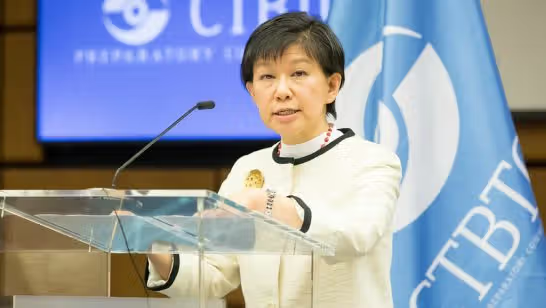
The United Nations has revealed that some of the weapons looted during Libya’s 2011 conflict eventually made their way into the hands of extremist groups operating in Nigeria.
Speaking at a meeting on the proliferation of illicit firearms at the UN headquarters in New York on Tuesday, the UN Under-Secretary-General and High Representative for Disarmament Affairs, Izumi Nakamitsu, said weapons stolen during conflicts often continue to fuel violence long after wars have ended.
Nakamitsu said weapons looted during the 2011 conflict in Libya resurfaced across the Sahel region and have caused devastation across peaceful communities.
“Libya, where weapons looted or diverted during and after the 2011 conflict, which ended the rule of Muammar Gaddafi, later surfaced across the wider Sahel region, including in Niger, Burkina Faso, and Nigeria,” Nakamitsu said.
“Some were subsequently found in the hands of extremist groups, illustrating how arms from one conflict can destabilise neighbouring countries years later.
“The end of the conflict does not mean the end of the circulation of those weapons; it stays, and it continues to harm people.”
She added that small arms proliferation can undermine peacebuilding efforts.
The high representative for disarmament affairs noted that weapons retained by armed groups, militias, and communities for self-protection can contribute to renewed violence and instability.
She pointed out that illicit weapons are linked to human rights abuses, terrorism, and sexual and gender-based violence.
“It is not just a security issue. It is also about peacebuilding. It is about human rights. It is also about development,” Nakamitsu said.
The under-secretary general said weapons used in conflict would continue to circulate, crossing borders and fuelling crime.
“Wars end, but unfortunately, the weapons that are used in that particular conflict would not be under full control,” she said.
“They continue to circulate. They are sometimes hidden. They are brought across borders.”
She added that the emergence of ghost guns, 3D-printed firearms, and sophisticated trafficking networks are creating new challenges for governments worldwide.
“Those weapons or weapon parts, if they are disassembled and then trafficked, are more difficult to trace.”


 Follow Us on Google Discover







Ebola: Akwa-Ibom govt intensifies surveillance after confirmed case in Abuja

UCL: Rice strikes late as Arsenal hold Bayern Munich to 2-2 stalemate

UCL: Mbappe shines as Real Madrid thrash RB Leipzig 4-1

Panic as gas emission hospitalize students, disrupts schools in Ogun

UCL: Man United suffer 4-1 defeat to Como as pressure mounts on Carrick

History and service have kept us intertwined – Tinubu celebrates Kwankwaso at 70

Tinubu meets NELFUND Chairman Jim Ovia at Aso Rock

‘Where is my house?’ – Ortom questions Alia over denial of ex-governor’s benefits

NCDC: FCT Ebola patient is a diplomat suffering multi-organ failure

AAC writes Tinubu, seeks approval to host presidential campaign council inauguration at Aso Rock

Reps pass bill to boost local drone manufacturing in Nigeria

10 injured in Third Mainland bridge crash as rescuers avert train collision in Lagos

Macron arrives in Saudi Arabia for surprise solidarity visit amid Houthi attacks

NDC rejects inclusion of C’River Chairman in APC campaign council

Gov Otu presents N987.8bn 2027 budget to Cross River Assembly

Proten International opens 18 job positions across states in Nigeria

TeamAce announces 64 job openings across Nigeria, with salaries up to ₦2 Million – Apply Now

R & R recruitment announces 31 job openings across Nigeria – Apply Now

BREAKING: DSS arraigns five suspects over abduction of 20 Prospective Corps Members in Imo

BREAKING: FG reports confirmed Ebola case in Abuja, identifies 44 contacts for tracing

Petrol subsidy return could crash naira to N4,000/$ – Oyedele warns

NLC upholds two-week ultimatum to FG over petrol prices, wage talks

Sanwo-Olu names Hassan Sanuth as new LAWMA MD

Nigeria would have gone bankrupt without fuel subsidy removal — Tinubu

Senate approves Sani Ndanusa’s appointment as ambassador-designate

Rivers Assembly reinstates three lawmakers after appeals

Delta govt declares three days of mourning for Former Governor Uduaghan

NUJ FCT Chairman celebrates brother Emeka on 40th birthday, commends his advocacy for Women’s rights

Reps launches investigation into Corps member’s death at Enugu camp
