
News
NSITF boss seeks stronger enforcement of Employees’ Compensation Act

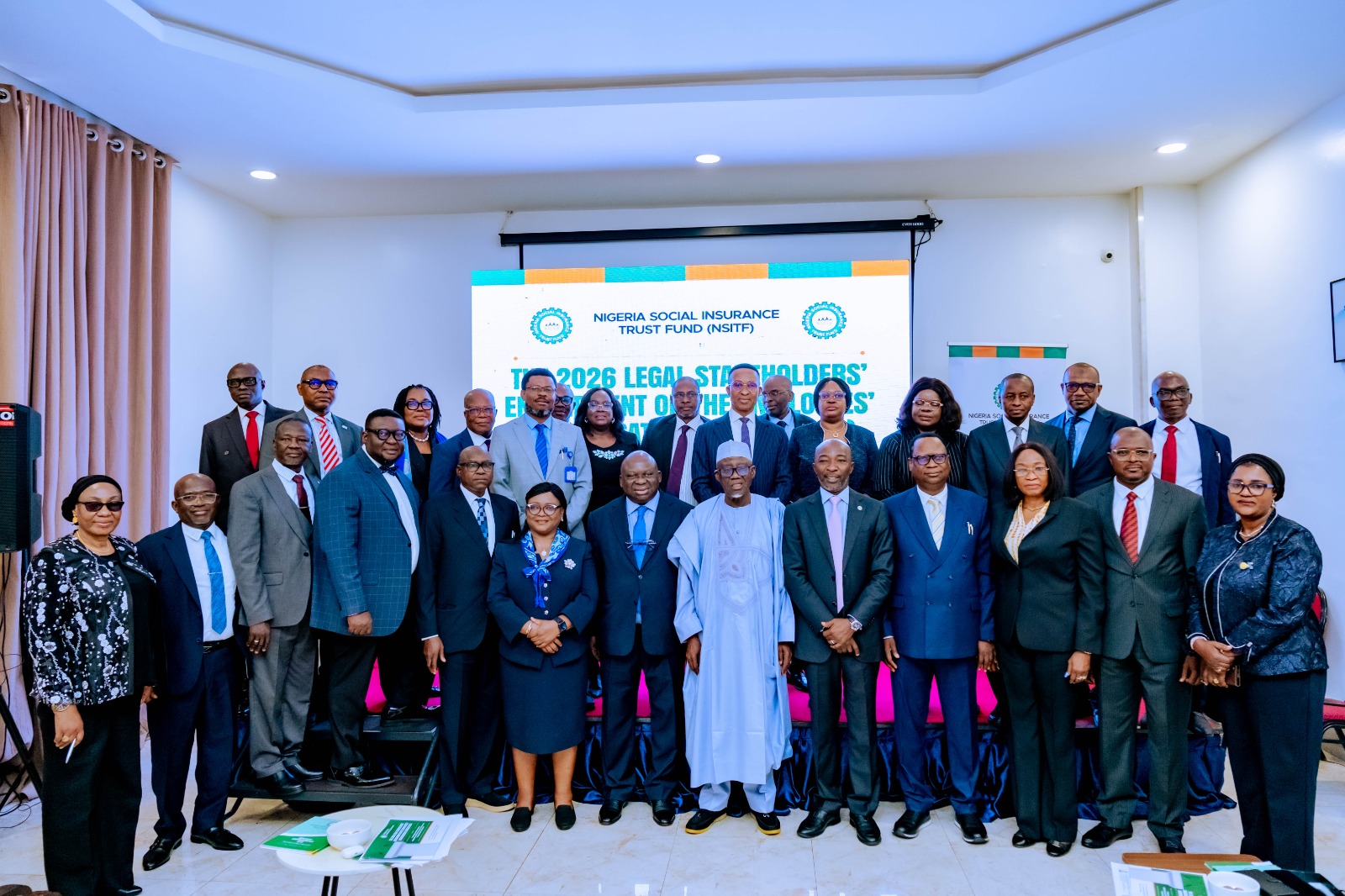
The Managing Director and Chief Executive of the Nigeria Social Insurance Trust Fund (NSITF), Oluwaseun Faleye, has called for stronger judicial interpretation, adjudication and enforcement of the Employees’ Compensation Act (ECA) 2010 to ensure Nigerian workers receive the protection and justice guaranteed by law.
Faleye made the call on Thursday during the opening of the NSITF 2026 Legal Stakeholders’ Engagement in Abuja. The two-day event is themed “Enhancing Judicial Interpretation, Adjudication and Enforcement under the Employees’ Compensation Act (ECA), 2010.”
He explained that while the previous edition focused on strengthening collaboration for the sustainable administration of the Employees’ Compensation Scheme, this year’s engagement centres on translating workers’ statutory rights into practical justice.
Using the experiences of workers across different sectors, including construction, manufacturing and transportation, Faleye noted that workplace accidents often trigger financial, emotional and social difficulties for affected employees and their families.
“Does the law provide a framework for protection? Yes. Does the Employees’ Compensation Act establish a system for compensation for work-related injury, disease, disability or death? Yes. But the existence of a law does not by itself guarantee that its promise will be fulfilled,” he said.
The NSITF chief identified legal interpretation, adjudication and enforcement as three critical stages that determine the effectiveness of the Act.
He said the law must be interpreted in line with its provisions and purpose, disputes must be resolved fairly and without unnecessary delays, and lawful judgments and orders must be enforced to ensure that justice does not end with a court pronouncement.
According to him, weaknesses in any of these areas could undermine public confidence in the entire compensation system.
Faleye also highlighted the role of the National Industrial Court of Nigeria (NICN) in labour justice, noting that its interpretation of the ECA has implications beyond individual disputes.
He said the court’s decisions help clarify the rights and obligations of employers and employees, guide workplace conduct and provide direction for resolving future compensation disputes.
For workers, he added, justice means receiving the benefits to which they are entitled, while employers need a predictable legal environment in which their obligations are determined fairly.
Faleye assured stakeholders that the NSITF would continue to improve its administrative processes, strengthen claims handling, raise awareness and encourage employers to comply with the law.
However, he acknowledged that the Fund could not achieve these objectives alone, urging participants to use the engagement to identify practical solutions, address areas requiring legal clarity, strengthen cooperation and reduce avoidable disputes.
“The value of a stakeholder engagement lies not merely in the quality of speeches delivered but in the clarity of understanding it produces and the improvements that follow,” he said.
He called for constructive deliberations that would produce actionable recommendations to improve the administration of the Employees’ Compensation Scheme.
“May our deliberations strengthen the rule of law and ensure that the promise of protection becomes a reality for Nigerian workers,” he added.
In his goodwill message, the Minister of Labour and Employment, Muhammadu Maigari Dingyadi, said the strength of a nation depended not only on the laws it enacted but also on how effectively those laws were implemented and the integrity of the institutions responsible for their administration.
He noted that although laws establish rights and define obligations, public confidence ultimately depends on the assurance that justice is administered fairly, impartially and with respect for human dignity.
Reflecting on the late Justice Chukwudifu Oputa’s observation that the judiciary is the last hope of the common man, Dingyadi said the statement carried a significant responsibility for the justice system.
He stressed that citizens often turn to the courts as their final option when other avenues for resolving disputes have failed, adding that such trust must be protected through sound judgment, integrity and fairness.
The minister reaffirmed the Federal Ministry of Labour and Employment’s commitment to building a just and productive society founded on respect for the law, responsible institutions and the public good.
He urged stakeholders involved in administering the ECA to uphold these principles, stressing that institutional credibility depended on the quality and integrity of actions rather than words alone.
Dingyadi commended the NSITF management under Faleye for organising the engagement, describing it as an important national initiative aimed at strengthening the implementation of the 2010 Act.
He also acknowledged the contributions of the President of the National Industrial Court, members of the Bench and Bar, and other participants.
Delivering the keynote address, the President of the National Industrial Court of Nigeria, Justice Benedict Bakwaph Kanyip, called for stronger collaboration among relevant institutions to improve the Employees’ Compensation Scheme and ensure that its benefits reach eligible workers and their dependants.
Kanyip commended the NSITF for providing a platform for discussions on improving the scheme, noting that sustained engagement with the judiciary could strengthen the Fund’s service delivery.
The event attracted senior government and judicial officials, including the President of the National Industrial Court, the Permanent Secretary of the Federal Ministry of Labour and Employment, judges, legal practitioners, employers’ associations, organised labour and development partners.
The programme also featured technical sessions on legal and evidential issues in compensation disputes, as well as challenges relating to compliance and enforcement.
The NSITF is a Federal Government agency under the supervision of the Federal Ministry of Labour and Employment. Established in 1993, it administers the Employees’ Compensation Scheme under the Employees’ Compensation Act 2010, which provides compensation to employees or their dependants in cases of work-related injury, disease, disability or death. The Fund also promotes occupational safety and health, rehabilitation of injured workers and compliance with the Act.


 Follow Us on Google Discover



Osimhen, girlfriend Stefanie Ladewig welcomes second baby

2027: INEC accepts 41 complaints, rejects 28 omitted governorship candidates

FIFA U-17 WWC: Quarter-final fixtures confirmed after round of 16

Everton end winless run with 3-1 victory over Newcastle, book q’final clash with Fleetwood

Inter, AC Milan unveil new Generali Stadium to replace iconic San Siro in 2031

JUST IN: Tinubu arrives in Saudi Arabia for Umrah

BREAKING: INEC clears Pantami, Gwarzo for 2027 elections, rejects Adebutu

NSITF boss seeks stronger enforcement of Employees’ Compensation Act

Bauchi Gov signs law establishing mining institute in Alkaleri

Katsina: 154 students hospitalised after suspected reaction to bilharzia drugs

Imo APC faults court ruling, insists Uzodimma remains senatorial candidate

ICPC re-arraigns Adeyemi over alleged N30.8bn fraud, forgery

Cyberbullying Trial: Sowore absent in Court, requests adjournment

Nursing mother sues husband over N10,000 monthly breastfeeding allowance in Kaduna

How did the 1,105% increase come about? Nigerians question INEC as Gov’ Okpebholo polling unit voters jumped from 397 to 4,783
BREAKING: Court sacks Hope Uzodimma, declares Okorocha winner of APC Imo West Senatorial Primary

BREAKING: Tinubu embarks on spiritual journey to Saudi Arabia, seeks prayers for Nigeria’s unity, stability
BREAKING: INEC clears Pantami, Gwarzo for 2027 elections, rejects Adebutu

TUC turns down FG’s N70,000 transport allowance, demands immediate salary increase

Anyone planning to rig the 2027 election will be rigged – Peter Obi speaks tough

Ronaldo beats Messi, others to win Best Ballon d’Or winner of All Time (B.O.A.T)

ADC postpones Sokoto Presidential Campaign Flag-Off to November 4

2027: INEC set to decide Pantami, Adebutu’s fate over omission from governorship candidates list

2027: ‘I can take a bullet for Tinubu’ — Kadana Governor, Uba Sani says

N70,000 Can’t fill a car’s tank, Atiku blasts Tinubu, says 6 Months relief is mockery of workers

Give Nigerians daily photos, videos of yourself in Makkah, Atiku tackles Tinubu, says trip could end in France

2027: ‘Follow me for latest updates, exclusive contents’ – Kwankwaso urges Nigerians as he joins TikTok

BREAKING: NELFUND launches token-based system to prevent double payment of school fees

2027: ADC raises alarm over alleged plot to postpone January 16 presidential election
