
National News
Xenophobia: Nigeria demands action over the killing of 98 citizens in South Africa since 2022

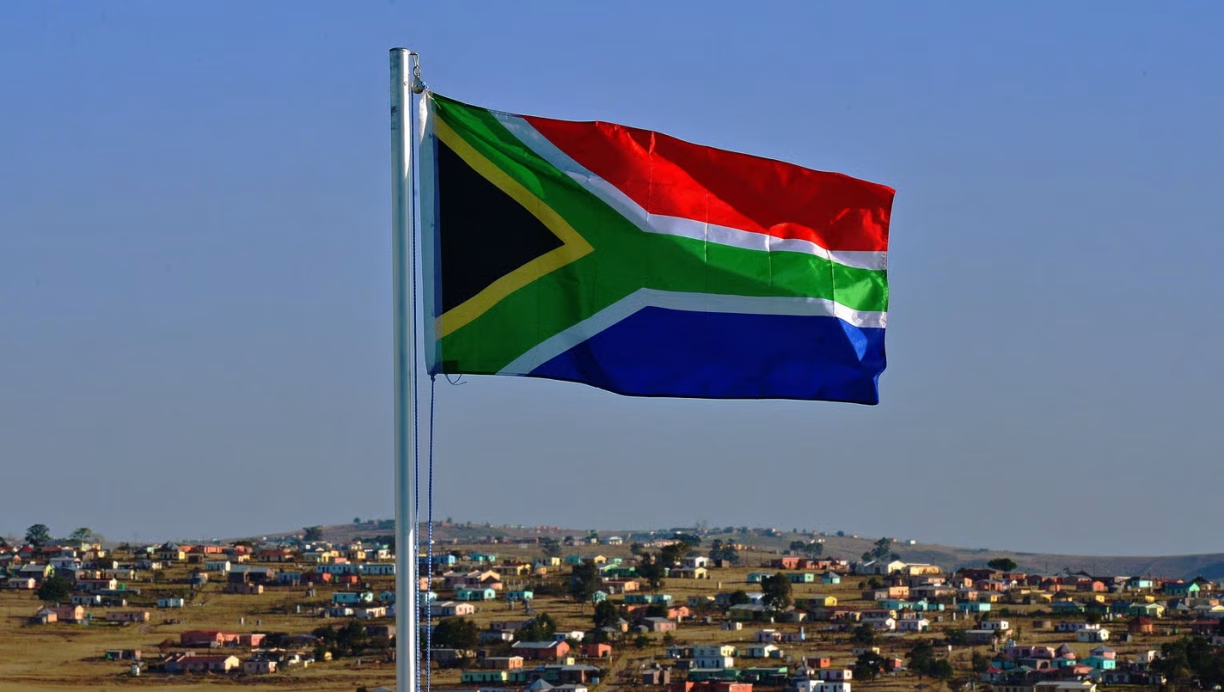
The Federal Government has called on South Africa to take immediate and concrete steps to end recurring Afrophobic attacks against Nigerians and other African nationals, revealing that no fewer than 98 Nigerians have been killed in mob and hate-related attacks in the country since 2022.
The demand was made on Monday in Abuja when South African President Cyril Ramaphosa’s Special Envoy and Minister of International Relations and Cooperation, Ronald Lamola, delivered a message from the South African leader to President Bola Ahmed Tinubu amid renewed concerns over the safety of Nigerians residing in South Africa.
Speaking after the meeting, the Minister of State for Foreign Affairs, Ambassador Sola Enikanolaiye, disclosed that President Tinubu had directed Nigerian officials to engage the South African delegation in frank discussions over the persistent attacks targeting Nigerians.
According to him, the recurring violence, which Nigeria described as Afrophobia, poses a serious threat to the longstanding diplomatic and economic relationship between Africa’s two largest economies.
Enikanolaiye recalled Nigeria’s pivotal role in supporting South Africa’s liberation struggle against apartheid, as well as its contribution to the transformation of the Organisation of African Unity (OAU) into the African Union (AU) and the establishment of the New Partnership for Africa’s Development (NEPAD).
He noted that xenophobic attacks have resurfaced repeatedly over the years, with major incidents recorded in 1995, 1998, 2006, 2015, 2016, 2019, 2021, 2024 and 2026.
According to the minister, official records indicate that 98 Nigerians have been killed in mob attacks and hate-related violence in South Africa since 2022.
While stressing that Nigeria does not condone criminality, Enikanolaiye maintained that individuals accused of committing offences should be arrested and prosecuted through the judicial system rather than subjected to jungle justice.
“Nigeria will not support drug traffickers or any criminal activity, but those accused of crimes must be treated in accordance with the rule of law, South Africa’s Constitution and international human rights standards,” he said.
The minister also questioned why South African security agencies had failed to prevent many of the attacks despite the fact that several of the victims were legally resident in the country.
He recalled the evacuation of nearly 1,500 Nigerians during previous waves of xenophobic violence, describing the experience as deeply emotional.
“I shed tears when I received the first batch of evacuees. I saw children, women and the elderly returning home with almost nothing after their properties had been looted and destroyed. That is not the Africa we want,” Enikanolaiye said.
He reaffirmed Nigeria’s commitment to maintaining cordial relations with South Africa, expressing optimism that both countries would deepen dialogue, rebuild confidence and uphold the ideals of African unity and solidarity.
Earlier, Lamola said President Ramaphosa had sent him to Abuja to reaffirm the enduring ties between both countries and engage the Nigerian government over concerns arising from attacks on foreign nationals in South Africa.
He acknowledged Nigeria’s historic contribution to South Africa’s anti-apartheid struggle, saying South Africans remain grateful for the sacrifices made by Nigerians.
“We remain deeply indebted to the people of Nigeria for their sacrifice,” Lamola said.
The South African minister reiterated that his government remains firmly opposed to xenophobia, racism, discrimination, homophobia and every form of intolerance.
However, he insisted that South Africa has a sovereign responsibility to enforce its immigration laws and combat irregular migration, drug trafficking, internet fraud and other criminal activities.
Lamola added that migration has become a continental challenge that requires stronger cooperation among African nations within the framework of the African Union’s policy on orderly and regular migration.
“We believe that Nigeria and South Africa have a shared responsibility to respond to these challenges within the African continent,” he said.
The meeting followed a recent telephone conversation between Presidents Bola Tinubu and Cyril Ramaphosa over renewed concerns about the safety of Nigerians living in South Africa and efforts to preserve one of Africa’s most significant bilateral relationships.
Headline options:
1. FG demands end to Afrophobic attacks, says 98 Nigerians killed in South Africa since 2022
2. Nigeria tells South Africa to stop Afrophobic attacks, reveals 98 citizens killed
3. FG raises alarm over killings of Nigerians in South Africa, seeks urgent action
4. Tinubu’s government urges South Africa to end Afrophobia as 98 Nigerians die
5. Nigeria presses South Africa over recurring attacks on citizens
6. FG condemns Afrophobic violence, says 98 Nigerians killed in South Africa
7. Nigeria seeks stronger protection for citizens as attacks persist in South Africa
8. FG to South Africa: End mob attacks on Nigerians, uphold rule of law
9. Nigeria, South Africa hold talks over renewed Afrophobic attacks
10. FG pushes for action against Afrophobia as death toll of Nigerians hits 98


 Follow Us on Google Discover







APM, Makinde sue Otti over alleged N200m campaign levy in Abia

‘Why are afraid of entering America?’, Atiku blasts Tinibu for missing third consecutive UNGA

Gunmen storm Kebbi community, kill village head

Former Kogi Gov Ibrahim Idris dies in UK

NDLEA seizes N3.4bn drugs, nab fake cop, mechanic

Falconets crash out of 2026 U-20 Women’s World Cup after 1-0 loss to Colombia

BREAKING: Tinubu confirms absence from 81st UN General Assembly in New York, directs Shettima to lead Nigerian delegation

2027: ‘Obi will defeat Tinubu by a wider margin in Lagos’ — NDC

NDC disowns OK Movement campaign council, refers John Ugulu for discipline

Raphinha set to sign new Barcelona contract until 2030

Four Nigerians receive UNGA Humanitarian, Goodwill Ambassador honours in New York

‘We Won’t Go Back to Egypt’ — Showunmi rejects Atiku’s petrol subsidy proposal

NSCDC names new Niger commandant following death of miners in custody

ECOWAS court set to hold 2026 international conference in Dakar

Nigerians already seeing reductions in transport fares – Tinubu
BREAKING: Tinubu confirms absence from 81st UN General Assembly in New York, directs Shettima to lead Nigerian delegation
Nigerians already seeing reductions in transport fares – Tinubu

Tinubu may shun UN General Assembly in New York – Fresh details emerge
‘We Won’t Go Back to Egypt’ — Showunmi rejects Atiku’s petrol subsidy proposal

‘Before lecturing Tinubu, you must answer questions from your past’ — Presidency to Atiku

‘The Site Belongs To Babangida’ – Survivor links deaths of miners in NSCDC custody to ex-Military Ruler

Deji Adeyanju, Buhari others appointed as FG constitutes committee to probe NSCDC custody deaths (Full List)
Four Nigerians receive UNGA Humanitarian, Goodwill Ambassador honours in New York

PL: Brighton thrash Arsenal 3-0, end Gunners’ winning run
Raphinha set to sign new Barcelona contract until 2030

NSCDC detains suspended Niger commandant, 21 officers over deaths of 37 miners

Why EFCC must prosecute Atiku – Agbonayinma
Falconets crash out of 2026 U-20 Women’s World Cup after 1-0 loss to Colombia
ECOWAS court set to hold 2026 international conference in Dakar