Editorials
Emotional Intelligence, Not Guns — What Wike’s aides should have done differently


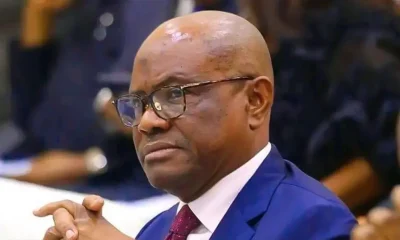
The recent public altercation involving Nyesom Wike, Minister of the Federal Capital Territory, has once again raised serious questions about the professionalism, composure, and intelligence of Nigeria’s security aides attached to politically exposed persons.
Those officers who escorted Wike to that scene of embarrassment failed the most basic rule of their training: protect your principal first, argue later.
In a visibly provoked environment, their immediate duty was to shield their boss and quietly extract him from danger. Instead, they stood frozen, motionless, waiting for chaos to unfold.
A properly trained security detail would have cordoned off the area, placed Wike in the middle, and tactically walked him away from confrontation.
Security work goes far beyond sirens, uniforms, and rifles, it requires emotional intelligence, quick thinking, and restraint.
Recalling an incident in 2010, during a narrators year of service as an aide to the late Minister of Health, Prof. Babatunde Osotimehin.
His convoy had accidentally hit a commercial motorcyclist in Kaduna.
Within seconds, an angry mob gathered, ready to lynch anyone in sight.
In that moment, the minister’s chief detail, Shola Aguda, acted with remarkable brilliance, he used the driver as a decoy, switched the minister into the driver’s seat, and quietly moved him through the crowd unnoticed.
Not a single shot was fired, yet a life was saved.
When we later asked how he pulled it off, his response was simple: “My first duty is to protect my principal from harm or embarrassment.”
That, precisely, is where Wike’s security aides failed.
They stood idle, watching their principal walk into self-inflicted humiliation.
Many of today’s aides are “yes-men,” more concerned with pleasing their bosses than performing their protective duties.
They forget that one wrong reaction in public could cost a principal not only reputation but also life.
Policing and protective service demand emotional intelligence, the ability to de-escalate, not inflame, situations involving powerful individuals. The police system urgently needs retraining in this area.
Beyond the tactical failure, the incident also exposes the diminished authority of Wike’s current office.
As a sitting governor, Wike wielded executive immunity under Section 308 of the 1999 Constitution, giving him unchallengeable control over state security. His Aide-de-Camp (ADC) and Chief Security Officer (CSO) then had the authority to neutralize perceived threats without fear of legal consequence.
But as Minister of the FCT, that constitutional shield no longer exists.
His protection now depends purely on administrative assignments, Police Orderlies and DSS officers operating under Sections 215 and 216 of the Constitution and the Nigeria Police Act, 2020. Unlike a governor’s ADC, they lack the legal power or autonomy to exercise force beyond basic protection.
This is why comparing a serving governor with a minister is legally inaccurate.
A Second Lieutenant of the Nigerian Navy can lawfully obstruct a minister in certain operational contexts, but never a sitting governor, unless acting on direct presidential instruction.
Wike knows this. That’s why in this latest incident, he reportedly reached out to the Chief of Defence Staff (CDS) rather than trying to assert the raw executive authority he once wielded as governor.
When he governed Rivers State, he once stormed a scene to stop the arrest of a sitting judge, an act that federal agents could not challenge because of his constitutional immunity. Similarly, Governor Usman Ododo of Kogi State recently prevented EFCC operatives from arresting his predecessor, Yahaya Bello, without consequence.
Ministers, however, are different. They hold influence, not immunity.
Their aides are escorts, not enforcers.
And that distinction must always guide their conduct.
The Wike incident is therefore not just about a clash of personalities, it is a lesson in protocol, hierarchy, and discipline.
Security officers must understand that their role is not to mirror their principal’s emotions but to manage them.
In public service, authority does not always mean immunity.
And as Wike himself may have realized, political power without constitutional protection can quickly turn a show of force into a show of weakness.


 Follow Us on Google Discover







NUJ FCT Chairman celebrates brother Emeka on 40th birthday, commends his advocacy for Women’s rights

BREAKING: DSS arraigns five suspects over abduction of 20 Prospective Corps Members in Imo

Nigeria would have gone bankrupt without fuel subsidy removal — Tinubu

Big blow for PDP as 21 LG chairmen, 226 councillors defect to APC in Adamawa

‘Life is better in Egypt’ – Rufai knocks Tinubu over fuel subsidy comment

Sanwo-Olu names Hassan Sanuth as new LAWMA MD

Petrol subsidy return could crash naira to N4,000/$ – Oyedele warns

Rivers Assembly reinstates three lawmakers after appeals

NLC upholds two-week ultimatum to FG over petrol prices, wage talks

BREAKING: Tinubu extends tenure of NCoS, Immigration service chiefs until 2028

Portugal hands Ronaldo 30-Day suspension, €255 fine for walking out of camp

Wike’s son Jordan dragged to EFCC over alleged $2.1m land fraud

Subsidy removal is here to stay, ‘we will never go back to Egypt’ – Tinubu

If Buhari a General could not end insecurity, you cannot blame Tinubu – Yari

Sanwo-Olu reportedly demands LAWMA boss’ resignation over mounting refuse in Lagos

BREAKING: Former Delta Governor Emmanuel Uduaghan is dead

‘₦29,000 Cannot sustain a retired officer’ — Atiku challenges Tinubu on police pensions, proposes initiative

Bauchi NDC governorship candidate Ibrahim Kashim resigns from party

Eight Nigerian Soldiers killed as ISWAP landmine hits Army patrol vehicle in Borno

2027: Tinubu must be stopped, ‘even Buhari saw him as bad news’ — Hakeem Baba-Ahmed

2027: “Which North? North Korea or North Carolina?” Nigerians mock politicians promising Tinubu Northern votes

2027: NDC will never step down for Atiku, stop attacking us – Kwankwaso replies ADC Campaign Council

FG defends fiscal reforms as World Bank flags ₦7.7tn debt interest

“I saw Akpabio at the State House begging Tinubu to keep his position” — Jake Epelle

Catholic priest dies after Jesus’ statue falls on him during mass in Ecuador (video)

FG to introduce fuel taxes when economy stabilises, Oyedele says

Wike, Akpabio, Uzodimma: Unity at the podium, rival ambitions behind the Scenes? can Tinubu keep his associates together?

Gregory University founder Gregory Ibe dies at 63

‘Nigeria cannot become prosperous in four years’ — Tinubu’s Economic Adviser says