Editorials
Rivers 2027: Tinubu’s fork in the road

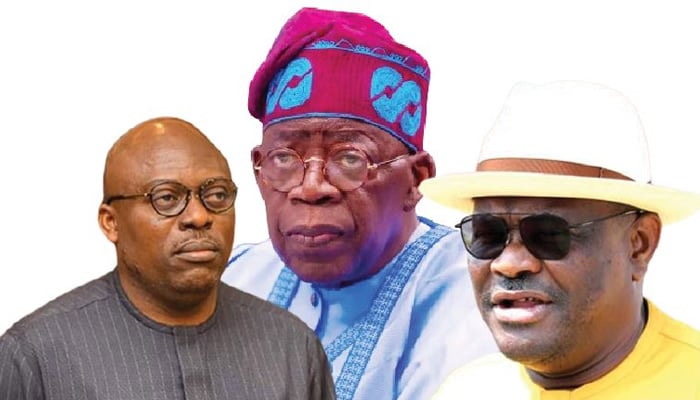
As the countdown to the 2027 general elections quietly begins, Rivers State has emerged as one of President Bola Ahmed Tinubu’s most delicate political puzzles.
It is a state too strategic to ignore, too volatile to mishandle, and too valuable to gamble with sentiment.
At the heart of the dilemma are two men locked in a bitter contest of relevance and control: Nyesom Wike, Minister of the Federal Capital Territory and former governor of Rivers State, and Siminalayi Fubara, the sitting governor who now flies the flag of the All Progressives Congress (APC).
Tinubu cannot have both. He must eventually choose.
For now, the President appears to be attempting balance, but balance, in Rivers politics, is often just a pause before collision.
Wike is a paradox Tinubu inherited and empowered. A card-carrying PDP heavyweight serving as one of the most powerful ministers in an APC government, Wike was instrumental to Tinubu’s controversial 2023 victory in Rivers.
His political machinery, coercive capacity, and deep-rooted networks delivered results where APC structures were weak.
But power borrowed is never power owned.
Fubara’s emergence in 2023 was initially read as Wike’s final masterstroke, a loyal successor installed to protect interests and extend influence.
That illusion did not last. The alliance fractured with alarming speed, descending into open warfare marked by legislative paralysis, institutional sabotage, and eventually, the unprecedented declaration of emergency rule in 2025.
That emergency rule, widely believed to have been engineered to halt an imminent impeachment, ironically became Fubara’s political lifeline.
While Wike’s allies consolidated local structures during the six-month interregnum, the suspension of democracy also froze Wike’s ultimate weapon, total capture.
When Fubara returned in September 2025, he returned wiser, leaner, and politically recalibrated.
His defection from the PDP to the APC was not ideological. It was survivalist.
In Nigerian politics, ideology rarely wins elections; alignment with power does.
Fubara aligned himself directly with the centre, not with Wike.
That singular move altered the Rivers equation.
Wike’s camp responded predictably, by questioning Fubara’s legitimacy within the APC and doubling down on claims of grassroots supremacy. But politics has evolved beyond ward registers and thugs.
Abuja now matters more than ever, and Abuja has spoken, if not officially, then unmistakably.
Daniel Bwala’s public affirmation that Governor Fubara must be allowed to govern without interference was not casual commentary. It was presidential positioning.
It signalled that Tinubu understands one immutable truth of Nigerian politics: a sitting governor, controlling state resources and security architecture, is not a man to be toyed with.
History is unkind to presidents who underestimate governors.
Those arguing that Wike remains indispensable point to 2023. But elections are not static events; they are contexts. Rivers in 2027 will not be Rivers in 2023. The variables have shifted. Wike no longer commands state instruments. He does not control the treasury. He does not appoint commissioners. He does not issue security directives.
Power has moved.
More troubling for Tinubu is Wike’s inability to disengage. His constant shuttling between Abuja and Port Harcourt, his obsession with Fubara’s political oxygen, and his relentless generation of conflict are becoming liabilities, not assets.
A minister who abandons his portfolio to fight a governor is not projecting strength; he is signalling insecurity.
The most brutal truth in this saga is one many are reluctant to say aloud: Rivers votes are not controlled forever by intimidation. Political fear has a shelf life. Wike’s style — confrontational, polarising, absolutist — may mobilise loyalists but alienates swing voters and moderates. In a post-subsidy, economically bruised Nigeria, Tinubu cannot afford to bleed goodwill unnecessarily.
Fubara, on the other hand, offers Tinubu something Wike no longer does — institutional stability. A governor eager to prove loyalty, consolidate APC structures, and deliver results without permanent crisis.
This does not mean APC will automatically win Rivers in 2027. Far from it. Rivers remains largely PDP in sentiment. But if Tinubu must gamble, logic dictates he gambles with the man who currently holds the steering wheel, not the one shouting from the back seat.
Those suggesting a permanent balancing act underestimate Nigerian politics. At some point, the President must choose clarity over convenience.
Rivers cannot be governed by proxy warfare indefinitely.
Tinubu’s silence may look strategic, but silence too long becomes weakness.
In 2027, Rivers will not reward nostalgia. It will reward control, legitimacy, and alignment with power.
The President knows this. His actions, not his words, are already beginning to show it.
In Rivers State, the era of godfather absolutism is fading. The age of governors negotiating directly with the centre has arrived.
Tinubu must decide whether to ride with the past or invest in the present.
History suggests presidents who hesitate lose both.


 Follow Us on Google Discover





2027: Kwankwaso a goat in sheep’s clothing, secretly working for Tinubu – Atiku Campaign Council

DSS arrests Maina’s fugitive son in Abuja, hands him over to EFCC

2027: Step down if you are not working for Tinubu – Deji Adeyanju dares Obi, Kwankwaso

2027: ‘I wont join my Uncle to support Tinubu’ – Davido says

Enugu NYSC death: NAFDAC debunks claims linking corps members death to fake drugs

33 Governors cannot be wrong in supporting Tinubu – Bayo Onanuga

Security forces arrest five suspects over abduction of 20 NYSC members in Imo

Rugby star Hyron Andrews dies at 31 after accidental fall in South Africa

LAUTECH Resident Doctors halt 50-day strike as Makinde intervenes

House Officers, Nurses, Radiographers, Others wanted as DELSUTH opens recruitment – Apply Now

FG raises health fund allocation to N40.76bn, extends insurance to prison inmates

Erisco Foods announces 13 job openings across Nigeria – Apply Now

Tinubu reappoints Bala Bila as INEC commissioner, nominates six others

2027: ‘Don’t trust your destiny to ‘kalokalo’ people’ – Wike warns Rivers voters against Atiku, Amaechi, Obi

BREAKING: Cross River PDP Chairman Venatius Ikem resigns, cites leadership crisis
Erisco Foods announces 13 job openings across Nigeria – Apply Now
‘You Betrayed Osun People’ — Adeleke, Davido face backlash over support for Tinubu

Ex-Senator Bello Mandiya’s body found in Abuja home three days after he slipped, hit his head in the bathroom

2027: Atiku, Obi, Makinde, Adebayo, Duke hold talks with six opposition parties
Tinubu reappoints Bala Bila as INEC commissioner, nominates six others

JUST IN: Finnish Appeal Court reduces Simon Ekpa’s jail term to four years, upholds terrorism conviction

‘I love Islam, I’ve sent people to Mecca to pray for me, Nigeria for 25 years’ – Akpabio

Over 10 soldiers, four civilians feared dead as Boko Haram terrorists attack Borno military base
House Officers, Nurses, Radiographers, Others wanted as DELSUTH opens recruitment – Apply Now

Zamfara govt set to empower 36,176 residents with Dangote shares

Umahi reopens first Niger bridge after emergency repairs, displays Tinubu’s photos

Panic in Rivers community as pipeline explosion injures 20, razes over 50 houses

Tension escalates as thugs attack NDC secretariat in Edo, destroy properties

Lagos govt announces 3-day traffic diversion on Independence bridge for emergency repairs
