National News
Latest World Bank report proves our reforms are working – Tinubu

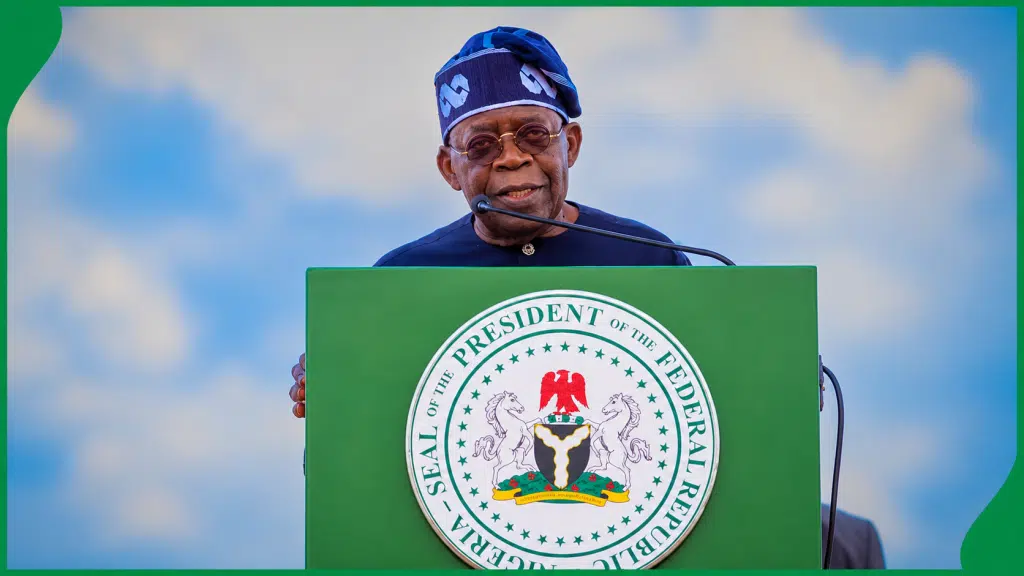
President Bola Tinubu has said his administration’s economic reforms are beginning to deliver results, citing improved economic growth, increased government revenues and stronger external reserves as evidence that Nigeria’s economy is on a firmer path towards sustained growth.
The President stated this in a statement issued on Sunday by his Special Adviser on Information and Strategy, Bayo Onanuga, reacting to the World Bank’s October 2026 Nigeria Development Update, titled Beyond the Federal Purse: How Higher Revenues Reshaped State Priorities.
According to Tinubu, the report indicates that Nigeria’s poverty rate has stabilised for the first time since 2019, with the World Bank projecting a gradual decline in poverty as economic growth outpaces population growth.
The President also highlighted the country’s economic performance amid the ongoing conflict in the Middle East, which has contributed to higher global fuel prices.
“The report shows the economy grew 4.2 per cent in the first half of 2026, up from 3.9 per cent in the first half of 2025, despite the impact of the conflict in the Middle East. The World Bank projects growth to average at least 4.4 per cent between 2026 and 2028,” the statement read.
Tinubu further noted that inflation had declined from 27.6 per cent in January 2025 to 15.2 per cent in December 2025, although rising global fuel prices had slowed the pace of the decline.
The World Bank, according to the statement, expects inflation to ease to approximately 12 per cent by 2028.
The President also pointed to improvements in Nigeria’s external position, noting that the current account surplus increased to $12 billion, representing 7 per cent of gross domestic product, in the first half of 2026, compared with $8.6 billion recorded during the corresponding period in 2025.
He added that gross external reserves rose from $45.5 billion at the end of 2025 to $53.8 billion by the end of August 2026.
Tinubu said the World Bank attributed significant revenue gains to reforms introduced since 2023, including the removal of the petrol subsidy and the unification of the foreign exchange market.
According to the statement, federation revenues increased by 69 per cent in real terms between 2023 and 2025, with state governments emerging as the biggest beneficiaries.
The additional revenue reportedly enabled states to increase capital expenditure by 151 per cent in real terms over the same period, with much of the spending directed towards roads and other transport infrastructure, agriculture, energy and housing.
The report also indicated that 29 of 33 states shifted their spending towards economic infrastructure, while real social spending per person increased in all but one state.
Tinubu further cited improvements in states’ internally generated revenue, debt management and the country’s overall public debt outlook.
According to the statement, internally generated revenue grew in real terms in 31 of 35 states, while 21 states reduced their debt-to-GDP ratios between 2021 and 2025.
Nigeria’s overall public debt is also projected to decline from 40 per cent of GDP in 2025 to 38.1 per cent in 2026, the statement added.
The President said the figures demonstrated the impact of his administration’s economic policies.
“These findings confirm that the difficult but necessary decisions to remove the petrol subsidy, unify the foreign exchange market and strengthen fiscal discipline have raised revenues, stabilised the economy and created fiscal space for every tier of government to invest in its people,” Tinubu said.
He, however, acknowledged that more work was required to ensure the gains translated into improved living conditions for Nigerians, particularly through lower food prices and increased employment opportunities for young people.
“The dividends of reform are becoming visible. But more work remains to ensure they fully translate into better living standards for every household, starting with lower food prices and decent jobs for our young people,” he added.
Tinubu said his administration would continue implementing its Renewed Hope Agenda, with a renewed emphasis on inclusive economic growth and improved access to essential services.
He listed targeted cash transfers, the expansion of compressed natural gas (CNG) deployment, improved agricultural productivity and increased access to affordable healthcare and quality education among the government’s priorities.
The President also urged state governments to manage their increased revenues more prudently and prioritise projects that directly improve the welfare of residents, particularly in healthcare and education.
He commended the Economic Management Team, led by the Minister of Finance and Coordinating Minister of the Economy, alongside state governors and other stakeholders, for their roles in implementing the reforms.
Tinubu expressed optimism that the next phase of his administration’s Renewed Hope Agenda would accelerate the delivery of economic benefits to Nigerians.


 Follow Us on Google Discover







Dauda Ali Biu, former FRSC Corps Marshal, dies at 62

2027: Obi is a ‘packaged fraud’, he’s secretly working for Atiku, positioning himself to become SGF – Sowere alleges

Amnesty International raises alarm, urges Wike to halt Maitama demolitions

INEC names Tinubu, Atiku, Obi, 15 others in 2027 presidential race (Full List)

Latest World Bank report proves our reforms are working – Tinubu

JUST IN: US publishes names, identities of 24 Nigerians facing deportation

UK varsities withdraw admissions of Nigerian students amid visa crackdown

2027 Elections: INEC publishes final list of governorship candidates nationwide (Full list)

‘Our ransom has been refunded’, says parents of abducted NYSC member

NDLEA rearrests 83-year-old Abia woman with hard drugs months after conviction

INEC omits Kwankwaso’s NDC governorship candidate Gwarzo from Kano final list

BREAKING: INEC clears Wike’s ally, Kingsley Chinda, for Rivers governorship race

2027: INEC excludes Pantami from final list of Gombe governorship candidates

2027: INEC omits PDP governorship candidate Adebutu from Ogun final list

2027: NDC set to inaugurate Presidential campaign council October 20
2027 Elections: INEC publishes final list of governorship candidates nationwide (Full list)

Benue APC delegates involved in road accident on way to rally
BREAKING: INEC clears Wike’s ally, Kingsley Chinda, for Rivers governorship race
INEC omits Kwankwaso’s NDC governorship candidate Gwarzo from Kano final list

Petrol prices climb across major cities as Port Harcourt depots hit N1,900/litre

JUST IN: ASUU calls off strike in three Lagos state universities

‘He needs urgent medical attention’ – Keyamo slams Atiku over criticism of Tinubu

NYSC kidnap: 20 freed corps members allowed to choose South-West states for posting
JUST IN: US publishes names, identities of 24 Nigerians facing deportation

Sultan of Sokoto announces date for Jumadal Ula moon sighting
2027: INEC omits PDP governorship candidate Adebutu from Ogun final list
2027: INEC excludes Pantami from final list of Gombe governorship candidates
NDLEA rearrests 83-year-old Abia woman with hard drugs months after conviction
2027: NDC set to inaugurate Presidential campaign council October 20