
Business News
Cooking Gas price rises to N1,300 Per Kg

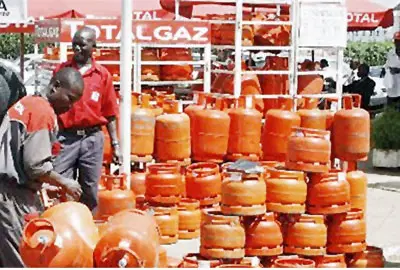
The price of Liquefied Petroleum Gas (LPG), popularly known as cooking gas, has risen to about N1,300 per kilogramme in Lagos, representing an 8.3 per cent increase from the N1,200 recorded in August 2026.
Checks in Lagos showed variations in prices across gas plants, with accredited outlets selling a kilogramme for about N1,300, while some smaller plants charge between N1,350 and N1,400, depending on their location.
Prices are reportedly higher in some other parts of the country.
The National President of the Nigerian Association of Liquefied Petroleum Gas Marketers, Inyang Edu, attributed the increase to a combination of factors affecting the domestic LPG supply chain.
Edu said global geopolitical tensions, including the conflict involving the United States and Iran, had contributed to volatility in international energy markets, with the impact being transmitted to the Nigerian market through several channels.
According to him, international energy prices, shipping and insurance costs, foreign exchange exposure, domestic transportation and LPG supply availability are among the factors influencing the current price.
“For Nigeria, the effect is transmitted through several channels: international energy prices, shipping and insurance costs, foreign-exchange exposure, domestic logistics and, most importantly for LPG, the availability and cost of supply into the domestic market,” Edu said.
He explained that the increase in replacement costs at the depot level had translated into higher prices for marketers and consumers.
“The immediate consequence is that the cost of LPG has increased along the entire supply chain—from the depot to the LPG plant and ultimately to the consumer.
“When the replacement cost of LPG rises at the depot, the marketer cannot continue selling at the previous price without making a loss,” he said.
Edu added that transportation, loading, financing, plant operations, personnel, maintenance and other logistics costs must also be recovered before the product reaches consumers.
He said the development was particularly concerning because millions of households and businesses now depend on LPG for cooking and other activities.
“This is particularly painful for households because cooking gas is no longer a luxury fuel. Millions of Nigerian families, restaurants, bakeries, food vendors, schools, hotels and other businesses now depend on LPG,” he said.
Edu warned that sustained increases in LPG prices could force some households to reduce their consumption or return to alternative cooking fuels such as firewood and charcoal.
“When LPG becomes unaffordable, some households are forced to reduce consumption or revert to alternative fuels such as firewood and charcoal. That undermines Nigeria’s clean-cooking objectives and can have serious environmental and public-health consequences,” he said.
The marketer also pointed to domestic supply challenges, recalling that the Nigeria Midstream and Downstream Petroleum Regulatory Authority (NMDPRA) reported an LPG supply deficit of about 91,966 metric tonnes year-to-date in June 2026.
According to Edu, the figure demonstrates that the domestic market has been dealing with supply constraints alongside international price pressures.
He explained that depot prices could change frequently based on product availability, the source of supply, location, logistics and commercial arrangements between suppliers and buyers.
Edu said available market information as of September 16 indicated that 20 metric tonnes of LPG in the Lagos market were being traded for between N20 million and N22.7 million, depending on the supplier and depot.
“As at September 16, 2026, publicly available market information indicates that 20 metric tonnes, MT, transactions in the Lagos market are broadly around N20 million–N22.7 million range, depending on the depot and supplier,” he said.
He cited current market listings showing approximately N22 million at Ardova, N22.7 million at Stockgap and about N20 million at Panocean.
Edu added that other market listings placed the price of 20MT between N19.9 million and N20.3 million, underscoring the differences in prices among suppliers and locations.
The latest increase adds to concerns over the affordability of cooking gas, particularly for households and small businesses that rely heavily on LPG for daily operations, amid continuing challenges across the domestic energy supply chain.


 Follow Us on Google Discover

FAAC shares N2.338tn August revenue to FG, States, LGs

DSS re-arraigns five alleged Ansaru leaders over Oyo School kidnap, two deaths

Sanwo-Olu, Fashola, Ambode, Gbajabiamila named as Lagos APC unveils 2027 Campaign Council (Full List)

South African woman sentenced to 25 Years for smuggling Heroin into Nigeria

FCE Yola Recruitment: 48 Academic and Non-Academic vacancies open (How to Apply)

Moniepoint announces 2 job vacancies for qualified Nigerians (How to Apply)

KolaDaisi University opens recruitment for Engineers, Analysts, 7 others positions (How to Apply)

Anambra Debt Record: Breeze has blown fowl yansh, Obi lies per second, He got away with it in 2023, but not this time — Keyamo

Tinubu won’t be happy with Wike for calling our Govs ‘lazy’ – APC Chieftain

I will resign if I fail to end insecurity in Zamfara within 2 Years – NDC guber candidate Marafa

Cooking Gas price rises to N1,300 Per Kg

Atiku’s Suit: Tinubu denies submitting fake NYSC Certification to INEC

National Assembly sends 2026 constitution amendment bill to 36 State Assemblies

Wike vs APC Governors: APC Campaign Council calls for Tinubu’s intervention

Tinubu is a very good man, He took over the country in shambles, but didn’t blame Buhari – Shettima

Nile University of Nigeria announces recruitment for 9 vacancies (How to Apply)

Obi left N127.37bn external debt, he borrowed for Malaria, Erosion control, others – Anambra Govt

Philomath University announces recruitment for 22 vacancies (How to Apply)

BREAKING: Veteran Nollywood actor Olu Jacobs dies at 84

Aisha Buhari visits Atiku as 2027 politics intensifies
Moniepoint announces 2 job vacancies for qualified Nigerians (How to Apply)
FCE Yola Recruitment: 48 Academic and Non-Academic vacancies open (How to Apply)

Now that Soludo has exposed you over N127.37bn debt, quit 2027 race — Presidency dares Obi

2027: Students across 19 Northern states, FCT endorse Tinubu for re-election
KolaDaisi University opens recruitment for Engineers, Analysts, 7 others positions (How to Apply)
Atiku’s Suit: Tinubu denies submitting fake NYSC Certification to INEC

Nigerians now begging me to slow down because freezers are freezing due to constant power supply – Minister Tegbe

2027: Atiku secures Court order to serve Tinubu through APC

Only Six of Nineteen Northern Governors supported Tinubu in 2023, Shettima reveals
