
Metro
Eight Nigerian Soldiers killed as ISWAP landmine hits Army patrol vehicle in Borno

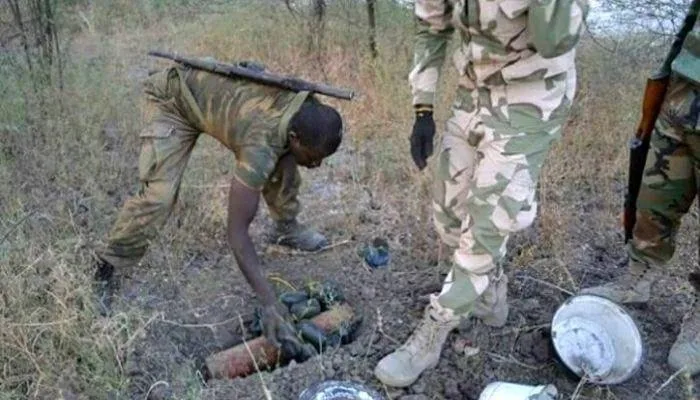
At least eight Nigerian soldiers have been killed after a landmine struck an army patrol vehicle in Borno State, with military and local security sources blaming the attack on Islamic State West Africa Province (ISWAP).
The incident occurred on Saturday in Kinuba village, about 25 kilometres from Gamboru, near Nigeria’s border with Cameroon, according to defence sources who spoke to Agence France-Presse (AFP) on Sunday.
The attack came on the same day the Chief of Army Staff, Lieutenant General Waidi Shaibu, visited Maiduguri, the Borno State capital, following an earlier assault on a military base that reportedly killed 15 soldiers and five members of an anti-jihadist militia.
According to the sources, troops were inspecting militia members engaged in clearing thick vegetation along a highway outside Gamboru when their vehicle ran over the explosive device.
The explosion killed all eight soldiers travelling in the vehicle.
“All eight soldiers in the vehicle were killed in the explosion,” a military officer in the region told AFP.
Ibrahim Liman, a member of an anti-jihadist militia supporting the military, corroborated the reported death toll, saying the explosive had been planted on the dusty road and remotely detonated.
“The explosive was planted on the dusty road and remotely detonated by a detonating cord,” Liman said.
He added that a militia member supervising the vegetation-clearing operation sustained shrapnel injuries in the blast.
The sources attributed the attack to ISWAP, an armed group active in the region. However, the attribution was based on the accounts provided to AFP.
Landmine Attacks Raise Security Concerns
The incident highlights the continuing threat posed by improvised explosive devices along roads used by military personnel and civilians in Nigeria’s North-East.
ISWAP and its rival, Boko Haram, have increasingly used landmines and other explosive devices to target military patrols and civilian traffic.
Dense vegetation along highways also provides cover for ambushes against troops and motorists, further complicating security operations in the region.
Nigeria’s jihadist conflict began in 2009 and has killed tens of thousands of people, while displacing an estimated two million residents from their homes in the North-East.
Although the violence declined from its peak about a decade ago, attacks have increased in recent years, according to the AFP report.
The insurgency has also affected neighbouring Niger, Chad and Cameroon, prompting regional cooperation and the deployment of a multinational military coalition to combat the armed groups.


 Follow Us on Google Discover







Eight Nigerian Soldiers killed as ISWAP landmine hits Army patrol vehicle in Borno

Bauchi Health Agency boss, four children die in Road accident

‘Nigeria cannot become prosperous in four years’ — Tinubu’s Economic Adviser says

2027: Tinubu must be stopped, ‘even Buhari saw him as bad news’ — Hakeem Baba-Ahmed

APC sweeps all 21 chairmanship seats, 239 Councillorship positions in Kogi LG poll

‘₦29,000 Cannot sustain a retired officer’ — Atiku challenges Tinubu on police pensions, proposes initiative

FG ends 17-year blackout in Gombe community with 1MW solar mini-grid

EPL: Leeds hold Man Utd to 1-1 draw as pressure mounts on Carrick

DSS arrests of NYSC kidnappers, Faisal Maina: Why intelligence must take centre stage: by Olufemi Lawson

SSANU halts two-week strike ultimatum after FG’s intervention

Catholic priest dies after Jesus’ statue falls on him during mass in Ecuador (video)

2027: NDC will never step down for Atiku, stop attacking us – Kwankwaso replies ADC Campaign Council

I fear APC’s internal crisis more than Atiku – Shettima

Why Shettima Insults Atiku: by Farooq Kperogi

Messi’s double fires Inter Miami to 3-1 victory over Atlanta United

2027: Step down if you are not working for Tinubu – Deji Adeyanju dares Obi, Kwankwaso

2027: Kwankwaso a goat in sheep’s clothing, secretly working for Tinubu – Atiku Campaign Council

Security forces arrest five suspects over abduction of 20 NYSC members in Imo

33 Governors cannot be wrong in supporting Tinubu – Bayo Onanuga

Opposition will front a single candidate against Tinubu, announcement will be made few days to election – Lukman

2027: ‘I wont join my Uncle to support Tinubu’ – Davido says

DSS arrests Maina’s fugitive son in Abuja, hands him over to EFCC

Gunmen kill four vigilantes in Plateau community

Veteran Journalist, diplomat Dele Cole dies at 86

Tension as traditional ruler collapses, dies in Ondo

Suspended NSCDC commandant apologises over deaths of suspected illegal miners in Niger
2027: NDC will never step down for Atiku, stop attacking us – Kwankwaso replies ADC Campaign Council

Ogun hospital under fire as Nurse dies of asthma attack amid alleged oxygen failure

COAS arrives Borno as Military moves to clear terrorist camps, rescue abductees
