News
Former INEC Chairman Mahmood Yakubu assumes duty as Nigeria’s Ambassador to Qatar

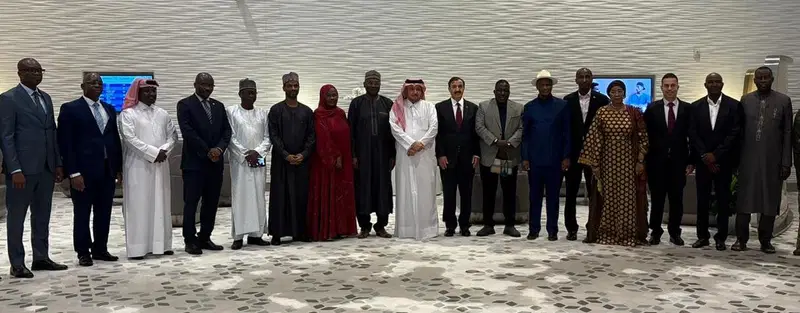
Former Chairman of the Independent National Electoral Commission (INEC), Prof. Mahmood Yakubu, has arrived in Doha to begin his assignment as Nigeria’s ambassador to Qatar.
Yakubu’s new role marks a transition from leading Nigeria’s electoral body to representing the country in one of the Middle East’s most influential nations.
The former INEC chairman completed his tenure at the commission late last year and was subsequently appointed ambassador by President Bola Tinubu as part of a series of diplomatic postings that attracted widespread public attention.
On arrival in Doha on Wednesday, Yakubu was received at the airport by Ambassador Ibrahim Yousif Abdullah Fakhro, Director of the Protocol Department at Qatar’s Ministry of Foreign Affairs.
The reception is seen as a formal recognition by the Qatari government of his diplomatic posting and the beginning of his official duties as Nigeria’s envoy to the Gulf nation.
The welcome party extended well beyond protocol officials as 13 African ambassadors turned out to receive Yakubu, alongside the Secretary General of the Gas Exporting Countries Forum, Dr. Philip Mshelbila, and Michael Ndukaihe Ihekwaba, President of the Nigerians in Diaspora Organisation in Qatar.
The breadth of the reception underscored Nigeria’s standing in Doha as a gateway to the African continent and hinted at the scale of expectations that will greet the incoming ambassador.
Yakubu’s posting to Doha is anything but a ceremonial reward or quiet retirement from public life. Qatar has evolved into a global nerve centre of diplomacy and sovereign capital, and Abuja is keen to deepen its footprint there.
The new ambassador inherits a brief that cuts across energy, investment, geopolitics, and diaspora affairs.
The most immediate pressure point is energy. The presence of Dr. Mshelbila — the Nigerian who heads the Gas Exporting Countries Forum, a body that Qatar co-dominates — at the airport was no coincidence. Nigeria and Qatar both sit atop some of the world’s largest natural gas reserves, and as the global energy landscape accelerates its transition away from crude oil, Yakubu will be expected to align Nigeria’s Decade of Gas initiative with Qatari technical expertise and investment capital.
A central challenge will be crafting complementary liquefied natural gas export strategies that attract Qatari investment into Nigeria’s midstream infrastructure without the two nations undercutting each other in global markets.
Beyond energy, Yakubu will need to translate President Tinubu’s economic reform programme — anchored on foreign exchange unification and subsidy removal — into concrete foreign direct investment flows from Qatar. The Qatar Investment Authority, the Gulf state’s sovereign wealth fund, manages assets in excess of $500 billion. Tapping even a fraction of that for viable Nigerian projects in agriculture, aviation, real estate, and digital infrastructure would represent a significant diplomatic dividend. The challenge, however, will be moving beyond the bilateral agreements that tend to gather dust in foreign ministries and into the transactional pitch rooms where investment decisions are actually made.
There is also a geopolitical dimension to manage. That 13 African ambassadors showed up to welcome Yakubu speaks to how Doha reads Nigeria’s continental weight. Qatar has in recent years positioned itself as a leading mediator in African and Middle Eastern conflicts, from Chad to Sudan. Yakubu will need to navigate those regional currents carefully, anchoring Nigeria’s role as West Africa’s dominant power while identifying where Nigerian and Qatari interests on peace-building and regional security genuinely converge.
Also, Nigeria’s presence in the Gulf is growing rapidly, shifting away from its traditional concentration in Western Europe and North America. Working alongside the Nigerians in Diaspora Organisation in Qatar, Yakubu will be expected to overhaul consular service delivery, protect the welfare of Nigerian professionals and labourers across the Gulf, and build structured pathways for channelling diaspora remittances into productive investment at home.
The former election umpire has spent his career administering processes. In Doha, the task is to deliver outcomes


 Follow Us on Google Discover






Gunmen storm Kebbi community, kill village head

Former Kogi Gov Ibrahim Idris dies in UK

NDLEA seizes N3.4bn drugs, nab fake cop, mechanic

Falconets crash out of 2026 U-20 Women’s World Cup after 1-0 loss to Colombia

BREAKING: Tinubu confirms absence from 81st UN General Assembly in New York, directs Shettima to lead Nigerian delegation

2027: ‘Obi will defeat Tinubu by a wider margin in Lagos’ — NDC

NDC disowns OK Movement campaign council, refers John Ugulu for discipline

Raphinha set to sign new Barcelona contract until 2030

Four Nigerians receive UNGA Humanitarian, Goodwill Ambassador honours in New York

‘We Won’t Go Back to Egypt’ — Showunmi rejects Atiku’s petrol subsidy proposal

NSCDC names new Niger commandant following death of miners in custody

ECOWAS court set to hold 2026 international conference in Dakar

Nigerians already seeing reductions in transport fares – Tinubu

PL: Brighton thrash Arsenal 3-0, end Gunners’ winning run

Sowore as best president Nigeria refuses to have: by Farooq A. Kperogi
BREAKING: Tinubu confirms absence from 81st UN General Assembly in New York, directs Shettima to lead Nigerian delegation
Nigerians already seeing reductions in transport fares – Tinubu

Tinubu may shun UN General Assembly in New York – Fresh details emerge

‘Before lecturing Tinubu, you must answer questions from your past’ — Presidency to Atiku
‘We Won’t Go Back to Egypt’ — Showunmi rejects Atiku’s petrol subsidy proposal

Deji Adeyanju, Buhari others appointed as FG constitutes committee to probe NSCDC custody deaths (Full List)

‘The Site Belongs To Babangida’ – Survivor links deaths of miners in NSCDC custody to ex-Military Ruler
PL: Brighton thrash Arsenal 3-0, end Gunners’ winning run

Anambra Debt Row: Expect more Peter Obi’s records in coming days – Presidency
Four Nigerians receive UNGA Humanitarian, Goodwill Ambassador honours in New York

Why EFCC must prosecute Atiku – Agbonayinma
ECOWAS court set to hold 2026 international conference in Dakar

NSCDC detains suspended Niger commandant, 21 officers over deaths of 37 miners
NSCDC names new Niger commandant following death of miners in custody