Editorials
From Battlefield to Cabinet: The high stakes before Gen. Christopher Musa

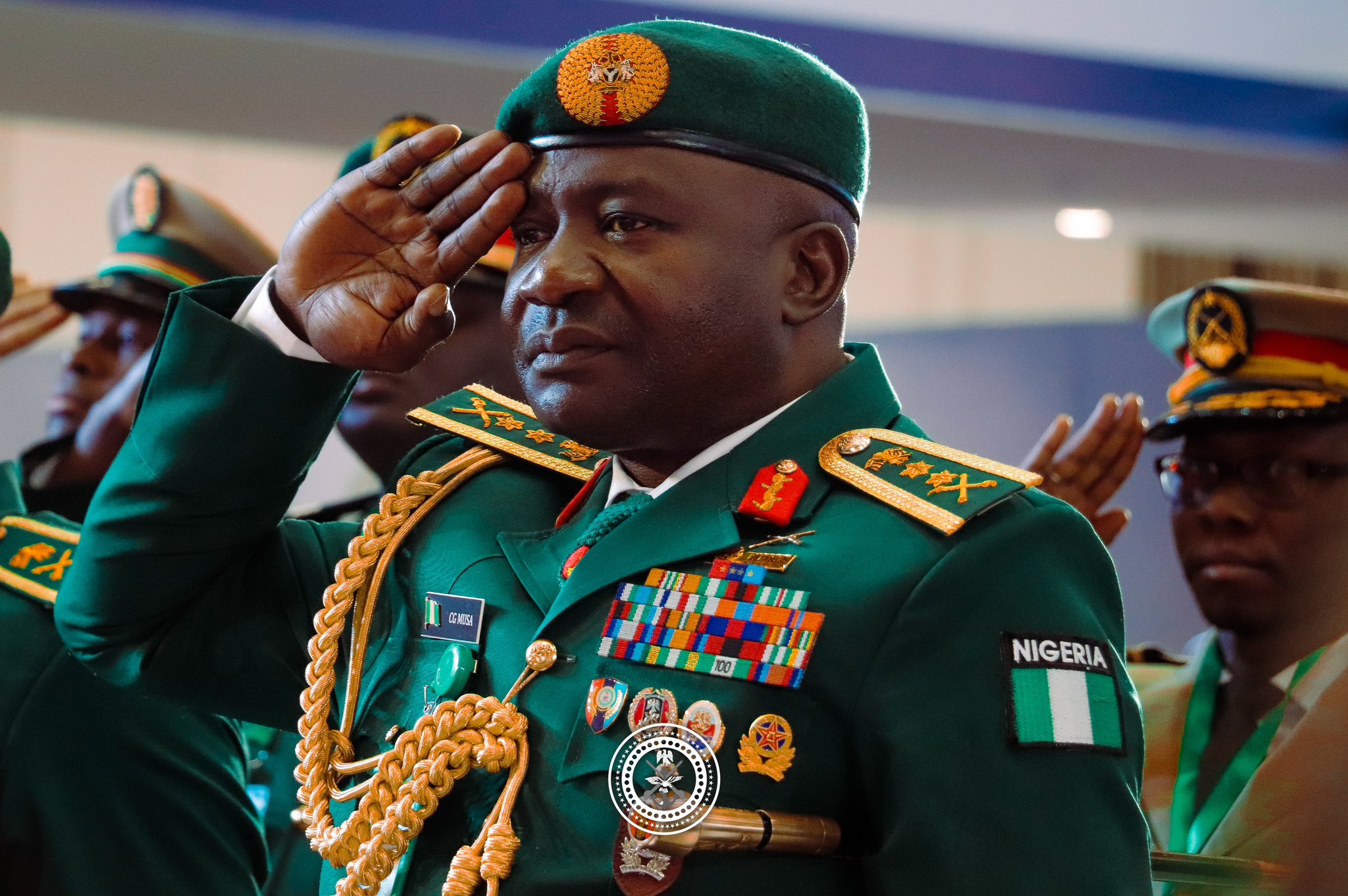
President Bola Ahmed Tinubu’s decision to nominate the immediate past Chief of Defence Staff, General Christopher Gwabin Musa (rtd), as Ministransformation, barely five weeks after his exit from service, has stirred both curiosity and cautious optimism across the country.
The speed of his recall, coupled with the sudden resignation of Mohammed Badaru Abubakar, signals that the Presidency is searching for a different kind of hands at a time when Nigeria’s security challenges have grown more complex and more urgent.
Those close to the Villa insist the President is convinced that the defence sector now requires a seasoned military mind, not a political figure, to pursue the next phase of counterterrorism and stabilisation efforts. In that regard, General Musa fits the bill.
His long service record, from Depot Commandant to Theatre Commander in the North-East, to Chief of Defence Staff, places him among the few officers with both deep field experience and strategic-level exposure.
Security analysts and retired senior officers echo this sentiment. Brigadier General Mohammed Galadanchi (rtd) argues that Musa’s understanding of military operations and his prior leadership roles make him well-suited to help the President implement tough policy decisions.
There is also the advantage of familiarity: the current service chiefs had worked under him, a dynamic that may smoothen coordination in a system often plagued by turf wars and bureaucratic competition.
His admirers often cite not just his operational firmness but also his capacity for inter-agency cooperation, something he demonstrated as Head of ECOWAS Military Chiefs, and earlier as Theatre Commander where he pushed kinetic and non-kinetic strategies simultaneously.
From Borno to Sokoto, Musa earned respect across communities divided by ethnicity, faith, or politics. In an era of suspicion and fragmentation, his broad acceptance is not trivial.
Yet, this appointment is not without shadows. General Musa leaves behind promises he could not deliver as CDS: the capture of bandit kingpin Bello Turji, the defeat of Zamfara’s bandit networks, and a clear turning point in the North-West crisis.
Those failures are not his alone, the system has long been overstretched, but they remain a stain he must now confront from a different seat.
The task ahead is formidable. In the North-West, banditry has mutated into a hybrid of terrorism and organised crime. Boko Haram factions are resurging in pockets of the North-East.
The North-Central faces escalating terror attacks and rural violence. Kidnappings in the South-South and South-West are rising sharply.
These problems demand more than familiarity, they demand innovation, political support, and institutional discipline.
General Musa now enters a ministry notorious for entrenched interests and decades-old practices.
As General Galadanchi warned, changing the culture of the ministry may prove more difficult than fighting insurgents in the bush.
To succeed, the new Defence Minister will need fresh minds, bold reforms, and credible advisory structures, possibly from retired senior officers who understand both command realities and policy bottlenecks.
Nigeria has had 12 Defence Ministers since 1999, alternating between civilians and military men. Some served in relative calm; others, like Godwin Abbe, stepped in as the insurgency was budding.
But none faced the level of national insecurity now confronting General Musa.
This appointment is therefore a gamble, one rooted in urgency and desperation for results.
If confirmed, General Musa must deliver not just coordination but breakthroughs.
The nation has no appetite for recycled strategies or unfulfilled assurances. The hour demands competence, courage, and clarity.
And now, Nigerian lives depend on his ability to turn military experience into policy transformation.


 Follow Us on Google Discover






Real reason we removed universities from IPPIS, recruitment waiver – FG

Macron condemns looting, vandalism during cost-of-living protests in France

Lagos State: List of LGAs, population, land mass, government, other key facts

Oyo State: List of LGAs, population, land mass, government, other key facts

Osun State: List of LGAs, population, land mass, government, other key facts

Ondo State: List of LGAs, population, land mass, government, other key facts

Eight Nigerian Soldiers killed as ISWAP landmine hits Army patrol vehicle in Borno

Bauchi Health Agency boss, four children die in Road accident

‘Nigeria cannot become prosperous in four years’ — Tinubu’s Economic Adviser says

2027: Tinubu must be stopped, ‘even Buhari saw him as bad news’ — Hakeem Baba-Ahmed

APC sweeps all 21 chairmanship seats, 239 Councillorship positions in Kogi LG poll

‘₦29,000 Cannot sustain a retired officer’ — Atiku challenges Tinubu on police pensions, proposes initiative

FG ends 17-year blackout in Gombe community with 1MW solar mini-grid

EPL: Leeds hold Man Utd to 1-1 draw as pressure mounts on Carrick

DSS arrests of NYSC kidnappers, Faisal Maina: Why intelligence must take centre stage: by Olufemi Lawson

2027: Step down if you are not working for Tinubu – Deji Adeyanju dares Obi, Kwankwaso

2027: Kwankwaso a goat in sheep’s clothing, secretly working for Tinubu – Atiku Campaign Council

Opposition will front a single candidate against Tinubu, announcement will be made few days to election – Lukman

2027: ‘I wont join my Uncle to support Tinubu’ – Davido says

Gunmen kill four vigilantes in Plateau community
‘₦29,000 Cannot sustain a retired officer’ — Atiku challenges Tinubu on police pensions, proposes initiative

DSS arrests Maina’s fugitive son in Abuja, hands him over to EFCC

Veteran Journalist, diplomat Dele Cole dies at 86

Tension as traditional ruler collapses, dies in Ondo

Suspended NSCDC commandant apologises over deaths of suspected illegal miners in Niger

Ogun hospital under fire as Nurse dies of asthma attack amid alleged oxygen failure

Buhari backed Osinbajo’s presidential ambition four times, Akande tells Babachir Lawal

2027: NDC will never step down for Atiku, stop attacking us – Kwankwaso replies ADC Campaign Council

Macky Sall quits race for UN Secretary-General position
